
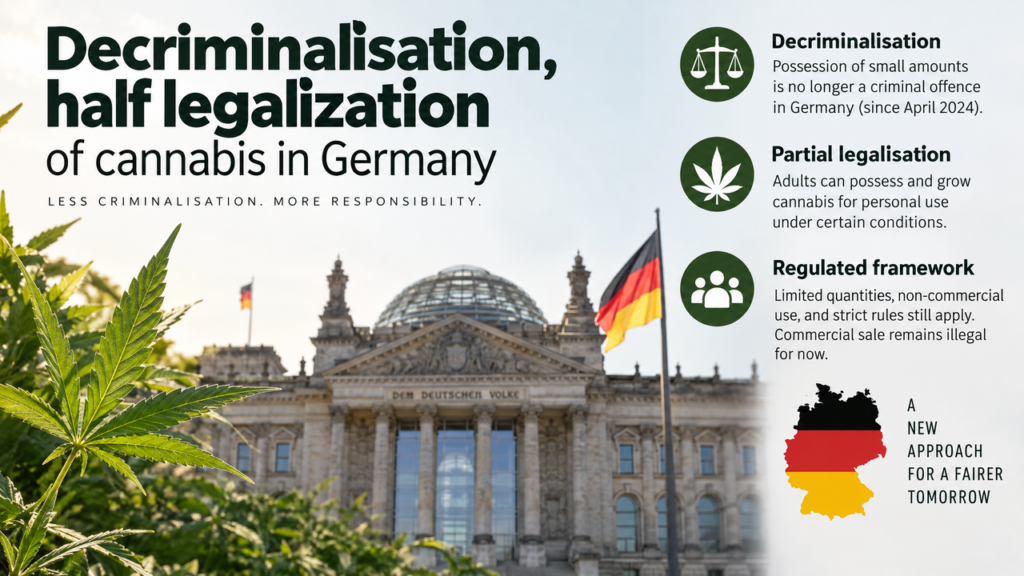
On April 1, 2024, Germany became the third country in the European Union—after Malta (2021) and Luxembourg (2023)—to take the step toward legalize cannabis. The decision, hailed at the time as a historic turning point, was passed by a vote of 407 to 226 in the Bundestag and presented by the “traffic-light” coalition (SPD, Greens, FDP) as the beginning of a new liberal era in drug policy.
Two and a half years later, the picture is more nuanced. On paper, Germany has indeed “legalized” cannabis. In reality, the day-to-day experience of German users bears much more resemblance to a decriminalization framework—reinforced by a limited network of associations—than to true legalization with a regulated commercial market, as seen in Canada or several U.S. states. An in-depth look at a reform that’s only halfway there.
What the German Law (KCanG / CanG) Actually Says
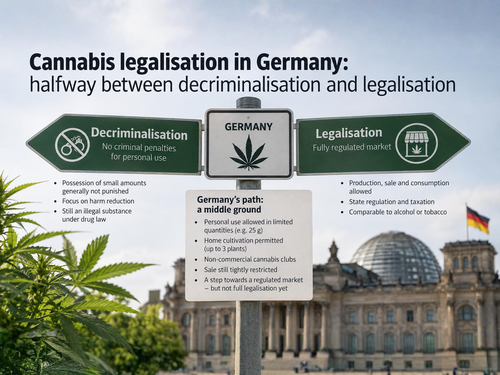
The German reform is based on the Konsumcannabisgesetz (KCanG), also known as the Cannabisgesetz (CanG), which was designed from the outset to consist of two distinct and independent “pillars.”
Pillar 1: Consumption, Personal Development, and Community Organizations (in effect since 2024)
This first section, which is the only one that has actually taken effect, authorizes:
- Possession of up to 25 grams of cannabis in public by adults
- Possession of up to 50 grams at home
- Personal cultivation of up to three plants per adult
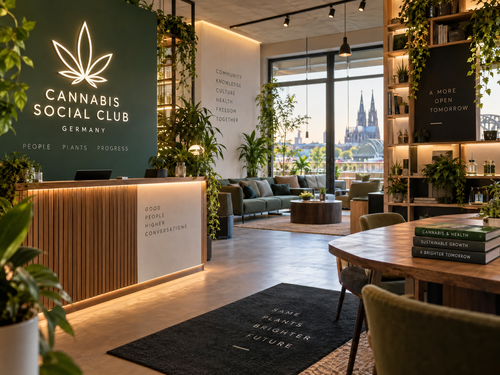
- Since July 1, 2024, the creation of “Cannabis Social Clubs ” (Anbauvereinigungen) has been permitted: these are nonprofit associations, limited to 500 members, authorized to grow and distribute cannabis exclusively to their members, up to a limit of 25 g per day and 50 g per month (25 g for those aged 18–21)
Cannabis has also been removed from the list of controlled substances (Betäubungsmittelgesetz), which has made it possible to expunge some of the criminal records related to simple possession.
Pillar 2: Commercial Sales, the Missing Link
This is where the problem lies. The initial proposal called for a second pillar: regional “model projects” (Modellprojekte) that would allow, on an experimental basis and under scientific supervision, the commercial sale of cannabis in specialty stores, following the model of the pilot programs conducted in Switzerland.
This provision was removed from the final text under pressure from the European Commission, which believed that an open commercial market would be incompatible with international conventions on narcotics. The government therefore committed to submitting it separately to Brussels once it had been refined.
More than two years after Pillar 1 took effect, this second pillar has still not been implemented anywhere in Germany. No commercial retail outlets have opened, and no pilot project has received full federal approval. Worse still: several municipal applications—and there were many (more than 49 interested cities, including Berlin, Frankfurt, and Hanover)—have been rejected by the Federal Office for Agriculture and Food (BLE), including Frankfurt’s in September 2025 and that of a Berlin district in November 2025.
The bottom line: The in-store sale of cannabis remains, to this day, strictly prohibited in Germany.
A shift in the majority that sealed the project's fate
The German political landscape shifted in May 2025 with the rise to power of Friedrich Merz (CDU), who led a CDU/CSU-SPD coalition. The CDU had made the outright repeal of the CanG law one of its campaign promises.
In fact, a coalition compromise has taken shape:
- The CanG Act has not been repealed: the SPD, the historic architect of the reform, has flatly refused to roll it back
- But Pillar 2 has been effectively put on hold, with no official timeline for its discontinuation or resumption
- Federal Agriculture Minister Alois Rainer (CSU) has come out as a staunch opponent of any further liberalization
- In the fall of 2025, the government announced an “open-ended review” of the law, leaving the future of the reform completely unclear
The most optimistic projections now suggest that pilot commercial sales could begin as early as 2027, provided that political will emerges by then—which, given the current climate, is far from certain.
Why this looks more like decriminalization than legalization
Several concrete examples illustrate this gap between the ambition set forth in 2024 and the reality on the ground today:
1. Legal access to the product remains extremely limited
Without a commercial market, the only legal sources of supply are personal cultivation and social clubs. However, these clubs are struggling to grow: as of October 31, 2025, only 366 clubs had been licensed nationwide, with a theoretical maximum of approximately 183,000 members, out of an estimated several million consumers. Some studies estimate that, at best, 3.5% of regular users actually obtain their supply through these organizations.
2. Individual home gardening is on the rise… by default
In the absence of a commercial distribution channel, a growing share of consumers has turned to growing their own crops from high-quality seeds : this accounted for only 5.4% of reported sources of supply in the first half of 2024, compared to more than 35% by the end of 2025. This shift is logical, but it clearly shows that the law did not create a true legal market accessible to all; rather, it shifted the burden of access onto the consumers themselves.
3. The black market hasn't disappeared
Without a sufficient legal supply, a significant portion of consumers continues to obtain cannabis outside of community-based networks or personal cultivation, for lack of a practical alternative. The decline in the number of cannabis-related offenses (approximately -34% in the first year) reflects, above all, the decriminalization of possession and use, rather than a massive shift toward a legal supply chain.
4. Medical cannabis has, de facto, become the main gateway
One of the most notable—and least anticipated—effects of the reform has been the surge in medical cannabis prescriptions, facilitated by online telemedicine. The number of patients rose from approximately 250,000 to more than 900,000 in 2025, a surge largely driven by recreational demand that shifted to the medical channel, which is easier to access than a social club. This trend has, in fact, prompted the government to tighten the regulations governing medical cannabis in late 2025 (requiring direct medical contact and prohibiting the mailing of prescriptions).
What the reform Has Changed After All
It would be unfair to dismiss the German law as nothing more than a mere illusion. Several real and well-documented effects should be highlighted:
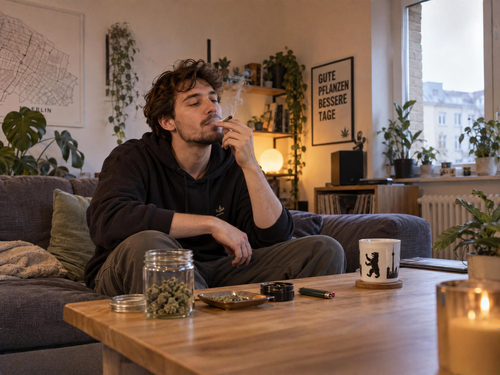
- Effective decriminalization of possession and use for personal purposes, with a measurable decrease in prosecutions and cannabis-related offenses
- A decrease in the product's price in certain segments, particularly the medical sector
- A greater willingness among users to seek care from healthcare professionals when needed, without fear of criminal penalties
- Consumption among adults has not skyrocketed, and consumption among young people has not increased, according to available studies
- A decline in heroin and amphetamine use has been observed since 2024, even as use of cocaine and synthetic drugs has been on the rise, as elsewhere in Europe
In summary: legalization based on only one of the two pillars
What Germany has implemented since 2024 amounts, in effect, to expanded decriminalization: possession, use, and personal cultivation are no longer subject to criminal prosecution, and a regulated community-based system allows for limited access to the product without resorting to the black market. However, the complete absence of a commercial sales channel—despite it having been announced as the second phase of the reform—deprives the system of what characterizes true legalization: a regulated, accessible market capable of genuinely competing with the underground economy.
With the current political climate far less conducive to further progress, “Pillar 2” may remain, for several more years, a promise yet to be fulfilled rather than a reality. Germany thus serves as a textbook example: that of a reform passed only halfway, caught between the initial ambition of a fully legal market and the caution—which has turned into reluctance—of a new government unwilling to go any further. Ultimately, this is a legalization process with many gray areas; let us hope for a more successful future development, in order to provide legal market guarantees that are more robust, stable, secure, and harmonious for the development of a healthier and more balanced cannabis industry for everyone as a whole.