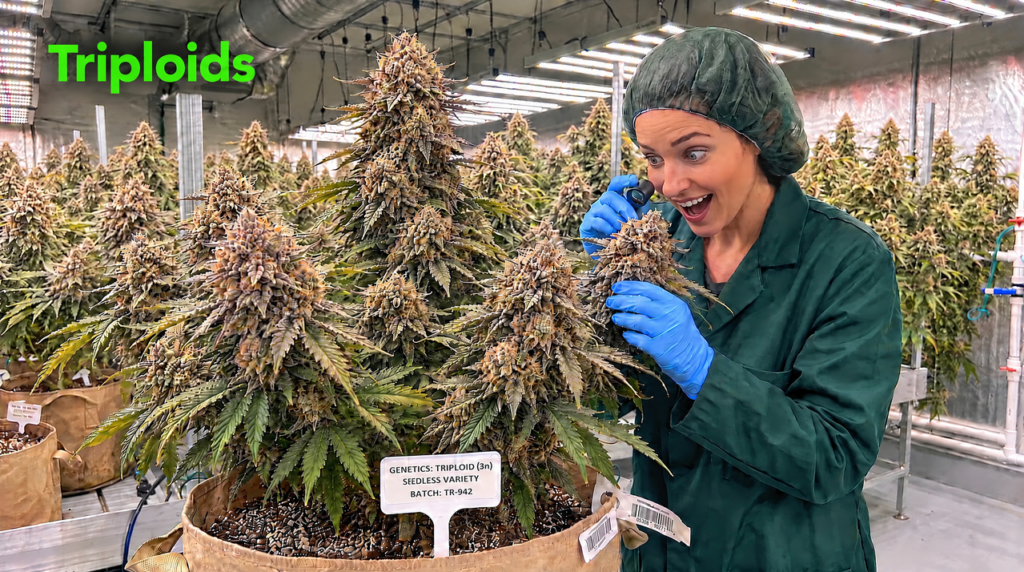
After feminized seeds and autoflowering strains, a new term is cropping up with increasing frequency in catalogs, trade shows, and specialized articles: triploid cannabis. Presented sometimes as the industry’s next genetic revolution, and other times as a mere marketing gimmick, it is generating as much enthusiasm as it is confusion.
So, where does the truth lie? In this article, we distinguish between what scientific studies actually show and what marketing claims sometimes imply, in order to assess the true potential of this technology.
What is a triploid plant?
Cannabis is naturally diploid (2n = 20): each cell contains two sets of chromosomes, one inherited from each parent. A triploid plant (3n = 30) has three sets.
This configuration has a major biological consequence: during the formation of reproductive cells, three sets of chromosomes cannot be distributed evenly. As a result, fertility is significantly reduced. This principle has long been exploited in other crops, such as seedless watermelons, certain bananas, citrus fruits, and apples.
Triploids also occur naturally in cannabis, but they are very rare. A study published in the journal *Plants* in 2023 documented this natural variation in ploidy within cannabis populations.
How do you create a triploid cannabis hybrid?
The most common method consists of two steps:
- Double the number of chromosomes in a diploid plant using a chemical agent (colchicine, or compounds from the dinitroaniline family, such as oryzaline) to produce a tetraploid plant (4n)
- Cross this tetraploid plant with a diploid plant: the seeds resulting from this cross produce triploid plants (3n)
This involves chromosomal manipulation, not genetic modification in the sense of inserting foreign genes. That said, the exact regulatory status of induced polyploid plants may vary by country and sector; it should be verified locally.
Promises: What We Often Hear
In commercial discourse, triploid cannabis plants are regularly associated with a number of benefits:
- Seedless flowers
- Higher returns, sometimes estimated at between +15% and +30%
- THC levels “exceeding 30–35%”
- Resin and terpenes are on the rise
- Increased resistance to hermaphroditism
Some of these claims are based on incomplete data, while others are primarily marketing pitches. Let’s see what the studies say.
What the Research Actually Shows
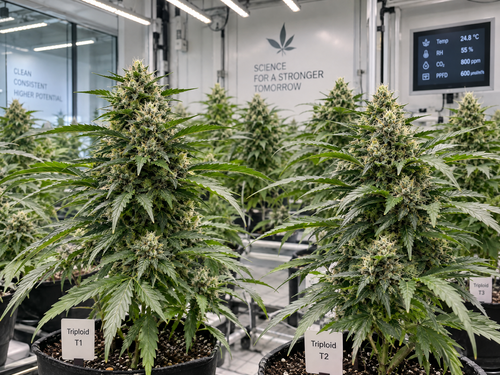
The real benefit: reduced seed production
This is the best-documented benefit, and it is well-established. In field trials of cannabinoid-rich hemp, published inthe *Agronomy Journal*, triploid varieties produced 77% to 87% fewer seeds than their diploid counterparts in the presence of pollen. Other studies on hemp lines have observed similar differences, with a seed-to-flower-biomass ratio of approximately 6.7 to 18% for triploids compared to 52 to 57% for diploids. One patent even mentions reductions of up to 98% in certain tested lines.
However, the presence of seeds in the flowers poses a real economic problem: it reduces the usable biomass, dilutes the cannabinoid concentration, and lowers the product’s commercial value.
But “seedless” does not mean “100% sterile.”
To be precise: cannabis triploids are not completely sterile. Several research groups have shown that they can produce seeds when exposed to pollen from diploid or tetraploid plants, and that this ability varies greatly depending on the genotype. A study comparing XXX and XXY triploids confirms that the ability to produce seeds depends heavily on the original genetics.
In other words, triploidy reduces the risk, but it does not provide complete protection.
Efficiency and Power: Much More Nuanced Results
This is where the gap between promises and data widens. In trials conducted under pollen-free conditions, researchers found no notable difference in seedless biomass or cannabinoid concentration between triploids and diploids. The gains observed in the presence of pollen are primarily due to the fact that diploids are hindered by seeds, rather than to any intrinsic superiority of triploids.
However, some studies have observed more favorable trends in specific strains. For example, a study on the CBG-rich hemp cultivar “Stem Cell CBG” found higher biomass and cannabinoid yields in the triploid version, while noting that no statistically significant increase in concentrations had been observed. Conversely, a patent mentions that, for certain strains, triploids have lower cannabinoid content than their parents.
The key takeaway: The effect depends on the initial genetic makeup, not on triploidy itself.
THC's Spectacular Numbers: To Be Taken with Caution
Claims such as “more than 30–35% THC” or “over 40% secondary metabolites” are primarily found in commercial content. Peer-reviewed studies do not, at this stage, support generalizing these claims. A high THC content is primarily linked to the chosen parental strain, not to the number of chromosomes.
The Real Benefits for the Industry
Despite these reservations, the potential is very real in several specific situations.
1. Outdoor cultivation and cannabinoid-rich hemp
This is where the benefit is most evident. Since cannabis is an anemophilous plant, its pollen can travel very long distances. In hemp crops grown for CBD or CBG, a single poorly managed neighboring field can jeopardize an entire harvest. Triploids offer partial protection against pollen drift in this context.
2. Large-scale production in greenhouses and controlled outdoor environments
For professional growers, every seed in a flower represents a loss of yield and value. Reducing this risk—even if it cannot be eliminated entirely—can have a significant economic impact on a large scale.
3. Extraction Methods
In production intended for extraction, flowers full of seeds dilute the cannabinoid concentration and complicate the processes. “Cleaner” biomass is a direct benefit.
4. Increased tolerance for growing imperfections
Triploids are no substitute for effective screening for hermaphroditic plants, but they can mitigate the consequences of accidental pollination.
5. A tool for competitive differentiation
For seed banks, triploids represent a valuable technological innovation, much like feminized seeds were in the past. In fact, patents have already been filed for methods of generating triploid cannabis plants.
Limitations and obstacles that should not be ignored
Triploids are difficult to produce in large quantities
A triploid cannot reliably reproduce from seed on its own. To obtain triploid seeds, it is necessary to maintain both tetraploid and diploid parents and repeat the cross each time. Seed production is therefore more complex and more expensive than with conventional diploid genetics.
Important note: Propagation by cuttings remains entirely possible. A triploid parent plant can be cloned just like any other, which opens up new possibilities for clonal production.
Limited potential for genetic improvement
Triploids make poor parents: their reduced fertility makes them of limited use in breeding programs. They will therefore never replace diploids. Breeding programs will continue to rely on diploid and tetraploid parents, as several experts have pointed out, describing triploids as a complementary tool rather than a replacement.
A threat to genetic diversity?
Several experts are concerned about the impact of the widespread dissemination of triploid genetics on cannabis biodiversity, which is already compromised by widespread hybridization and the erosion of landraces. The danger does not stem from triploidy itself, but from the potential for standardization around a small number of commercial strains.
Results that are highly dependent on genotype
Studies consistently show that the response to polyploidy varies from one strain to another. Some show little difference in growth compared to diploids, while others exhibit marked variations in morphology or cannabinoid profile. Each strain therefore requires its own testing, which slows down development.
Consumer Perception
Some consumers—particularly those who enjoy “craft” cannabis or traditional strains—may be reluctant to try a plant produced through chemical treatment, even if that treatment is applied only to the parent plants and does not involve any transfer of genes.
Triploidy: Revolution or Niche Tool?
To clarify, here is a summary of what science currently supports:
| Common claim | Current State of Knowledge |
|---|---|
| Sharp decline in seed production | Well-documented (reductions ranging from 77% to 98%, depending on the strain and study) |
| Completely sterile plants | Inaccurate: risk reduction, not absolute sterility |
| Superior Performance | Variable: mainly related to the absence of seeds; little difference in the absence of pollen |
| Significantly higher THC and terpenes | Not generally demonstrated; highly dependent on the lineage |
| Total Resistance to Hermaphroditism | Not proven: We must continue to eliminate genetically unstable lines |
| Suitable for breeding | No: bad parents, limited role |
| Interest in hemp and outdoor cultivation | Real and solid |
The Outlook: What Can We Expect in the Coming Years?
Triploid cannabis is likely to find its place, but more as a specialized tool than as a widespread revolution. Its best chances for success lie in:
- Cannabinoid-rich hemp (CBD, CBG), where pollen drift is a major economic problem
- Large-scale outdoor or greenhouse operations seeking to protect their crops
- Extraction processes that are sensitive to the purity of the biomass
- Seed banks looking to expand their offerings with innovative genetics
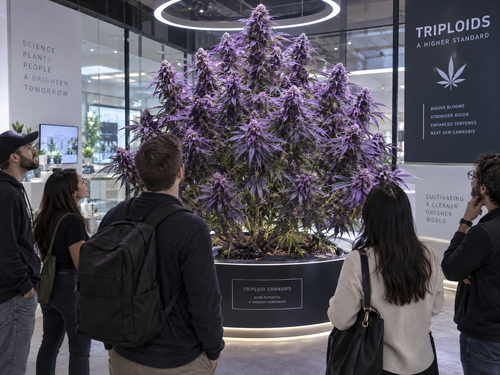
For the hobbyist grower or passionate breeder, the appeal will be significantly more limited: pollination control indoors is already well-managed, and the value of a strain lies primarily in its inherent qualities (aroma, effect, resistance, structure), regardless of its number of chromosomes.
In summary
Triploid genetics is neither a mirage nor the revolution heralded by some proponents. It is a serious agronomic tool whose main benefit—a marked reduction in seed production—is well established, but whose promises of superior yield and vigor remain largely dependent on the initial genetic material and have yet to be sufficiently demonstrated.
Its true potential for the industry lies less in a dramatic increase in yield than in more reliable harvests and more consistent quality on a large scale. As is often the case in genetics, what matters most is not the technology itself, but the quality of the breeding work that goes along with it.