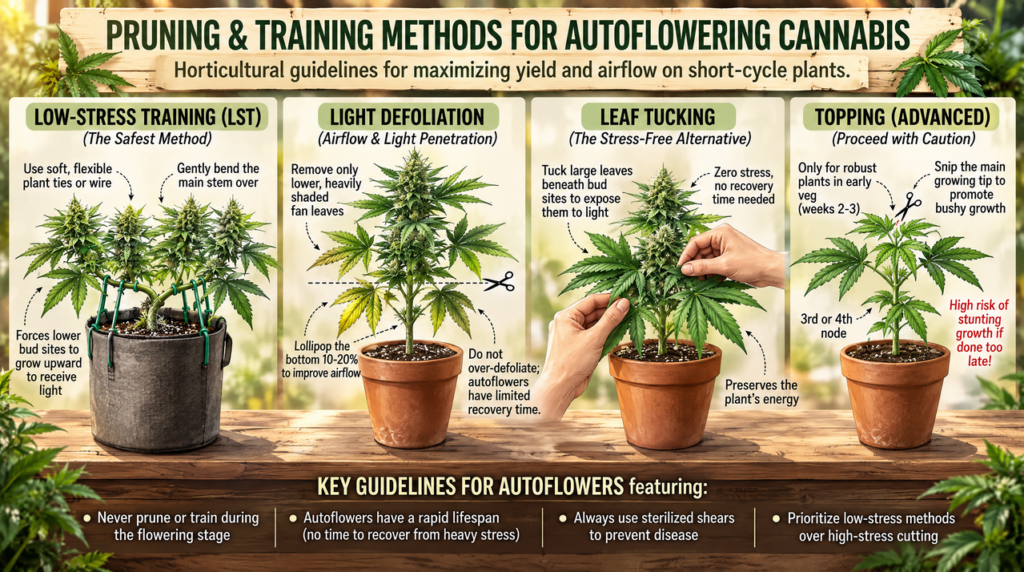
Yes, it is entirely possible to prune an autoflowering cannabis plant, but with some caution; we recommend doing so early on, and always prioritizing techniques that minimize stress on the plant. With photoperiod varieties, pruning is a standard method for increasing yield. With autoflowering varieties, however, the same practice can actually stunt the plant’s growth at the worst possible time.
This issue has divided growers ever since cars first hit the market. Some never touch their plants, while others successfully practice topping. Here’s what you need to know to make the right choice.
What Sets the " autoflowering " Apart
An autoflowering hybrid blooms automatically based on its age, usually after 20 days of growth, regardless of the light cycle, whether grown indoors or outdoors. This trait is genetically derived from Cannabis ruderalis, a subspecies adapted to the short summers of northern regions.
As a direct result, its life cycle is short and fixed, generally lasting 8 to 12 weeks from seed to harvest. The vegetative growth phase lasts only 3 to 4 weeks at most, and the grower cannot extend it, even with the use of specialized equipment.
With a photoperiodic cultivar, it’s entirely possible to let the plant recover from pruning for as long as necessary before triggering flowering. With an autoflowering strain, every day lost to growth is lost for good and cannot be made up for. This clearly means that it is essential to strive to ensure ideal growing conditions—particularly climatic ones—as much as possible, in order to best prepare the plant’s structure for flowering and achieve the highest possible yield at harvest time.
The Risks of Pruning Autoflowering Plants
Any major pruning can cause stress, as the plant needs a few days to heal, recover, and reorganize its growth. For an autoflowering plant, this recovery time is taken from an already very short vegetative phase. It’s also important to know that not all cannabis strains react the same way to the stress they face during this process; some will show beneficial results, while others, on the contrary, will yield inconclusive or counterproductive results, leading either to a stalling of the plant’s structural development or, conversely, to a beneficial burst of structural growth, which in this case could result in a harvest with a much higher yield.
The main risks of pruning certain autoflowering varieties:
- Slowed growth: The plant uses its energy to repair itself rather than to grow.
- Smaller plant: If flowering begins before the plant has recovered, it will remain stunted, with few branches, and small.
- Declining performance: the opposite of what was intended.
- Irreversible mistake: If you prune too late, there isn't enough time to make up for it.
The most compact and fastest-growing varieties are the most sensitive. A weak, diseased, or nutrient-deficient plant should never be pruned, as this could weaken it even further.
At SILENT SEEDS, we recommend always starting with small-scale tests on a single plant first, to observe how it responds and to obtain precise results for a specific variety, rather than applying the method to an entire population, which could lead to disappointing and unexpected results. It’s always best to err on the side of caution to minimize losses, especially indoors where space is limited and energy costs are higher.
We also recommend applying the same safety protocol to photoperiod cannabis strains, as most strains descended from or belonging to the Girl Scout family lineage Cookies , for example—will not respond favorably to various pruning techniques; this is an observed and proven fact. The same applies to the vast majority of hybrids derived from the Gelato lineage, which may exhibit signs of hermaphroditism as a result of the stress they experience. It’s clearly important to exercise caution with many modern polyhybrids, more commonly referred to as exotic cannabis strains.
It’s certain that by applying these same pruning methods to more traditional cultivars belonging to the Skunk and Haze lineages (such as Moby Dick Auto for example), Afghan, Hindu Kush (old strains), Chitral, Pakistani, or Northern Lights, your crop will be more likely to develop in the right direction thanks to the stability of these “old-school” genetic lines. The results in this case demonstrate a very different and more predictable reliability; however, certain exotic varieties yield convincing results once this initial testing phase is completed.
Possible techniques
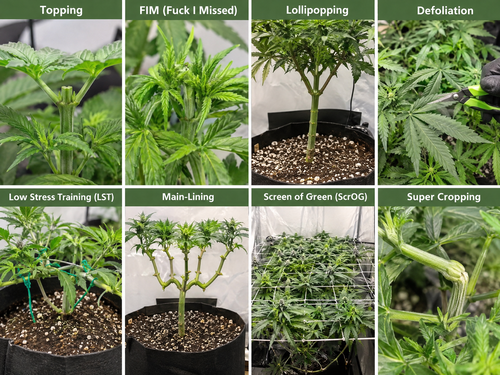
Not all pruning methods are created equal: pruning without cutting is the safest approach for autoflowering plants, while severe pruning is the riskiest.
| Technical | Principle | Stress | Suitable for cars? |
|---|---|---|---|
| LST (light trellising) | Bend and tie the stems to expose the plant to light | Low | Yes, ideal |
| Lollipopping | Remove the small, lower shoots that don't get much sunlight | Low | Yes, right at the start of flowering |
| Mild defoliation | Remove a few large leaves that are covering the heads | Moderate | Yes, in moderation |
| FIM | Pinch off the terminal bud, cutting off only a portion of it | Moderate | Possible, on vigorous varieties |
| Topping | Cut off the tip to create two main stems | High | Risky, only very early on |
| Mainlining, super cropping | Repeated pruning or crushed stems | Very high | Not recommended; should be avoided |
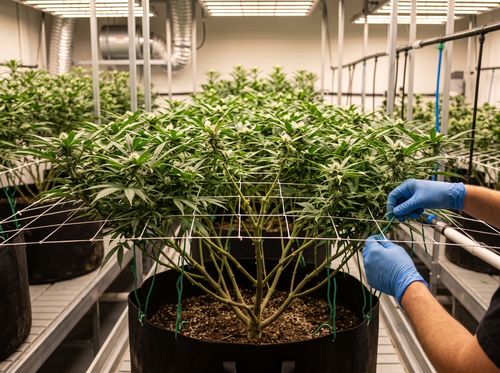
LST offers the main benefits of pruning—a more uniform, evenly distributed canopy with more well-lit buds—without any cutting. It is the standard technique for cannabis hybrids autoflowering, as this method effectively reduces all stress on the plant(s) in question.
Good timing
With autoflowering plants, timing is just as important as technique: a drastic pruning should be done no later than the third week, after which you should only prune gently.
| Time frame (approximate) | What We Can Do | What to Avoid |
|---|---|---|
| Weeks 1–2 | Let the plant settle in | Any size |
| Weeks 2–3 | Topping or FIM on a very vigorous plant (4 to 5 nodes), start of LST | Prune a weak plant |
| Weeks 3 through 5 | Continue with the LST; slight defoliation | Topping and FIM |
| Start of flowering | Lollipopping: carefully removing a few troublesome leaves—the ones that actually block the flowers from developing | Clean cuts |
| Advanced flowering | Nothing, except damaged leaves | Any size |
These guidelines vary by variety: pay attention to the plant rather than the calendar. The appearance of the first pistils signals the start of flowering and the end of major care tasks.
The Verdict: Our Practical Tips
For most growers, the best strategy is to avoid pruning—except for light defoliation or moderate lollypopping—and to generally rely on LST. Hard pruning remains an option for the most experienced growers, on vigorous strains that demonstrate a certain resilience. As mentioned earlier, you’ll need to gain your own experience over time, as certain strains demonstrate that it’s possible to achieve excellent results using a wide variety of methods—but this requires taking the time to educate yourself through a multitude of hands-on experiments of your own, which is your best way to discover the possibilities truly available to you in the world of autoflowering cannabis strains.
- Beginner: no trimming. A simple LST is enough to significantly improve the canopy.
- Experienced grower: just one topping or FIM, at the right time, on a healthy plant.
- Choose the right strain: XXL autoflowers like Alien Gas XXL Auto, MAC Dawg XXL Auto, or Purplenade XXL Auto, or longer-cycle varieties tolerate pruning better than compact varieties, which also have a shorter flowering period.
- Only one major procedure: never perform two drastic prunings on the same car, because otherwise it may never have enough time to recover sufficiently.
- Take good care of the plant's environment: the right lighting, watering, and nutrition will help it recover more quickly.
- Test before applying the results more broadly: compare a pruned plant with an unpruned plant of the same variety. Test, analyze, and conduct your own experiments.