For a long time, the golden rule of watering could be summed up in one sentence: “Water when the pot feels light.” Today, the most knowledgeable growers talk about “dryback”, a term derived from professional greenhouse horticulture.
Dryback refers to the amount of water the growing medium loses between waterings. Far from being a mere detail, it affects root health, nutrient uptake, and even the way the plant allocates its energy between foliage and flowers. When properly managed, it is one of the most powerful tools for guiding crop growth.
What is dryback?
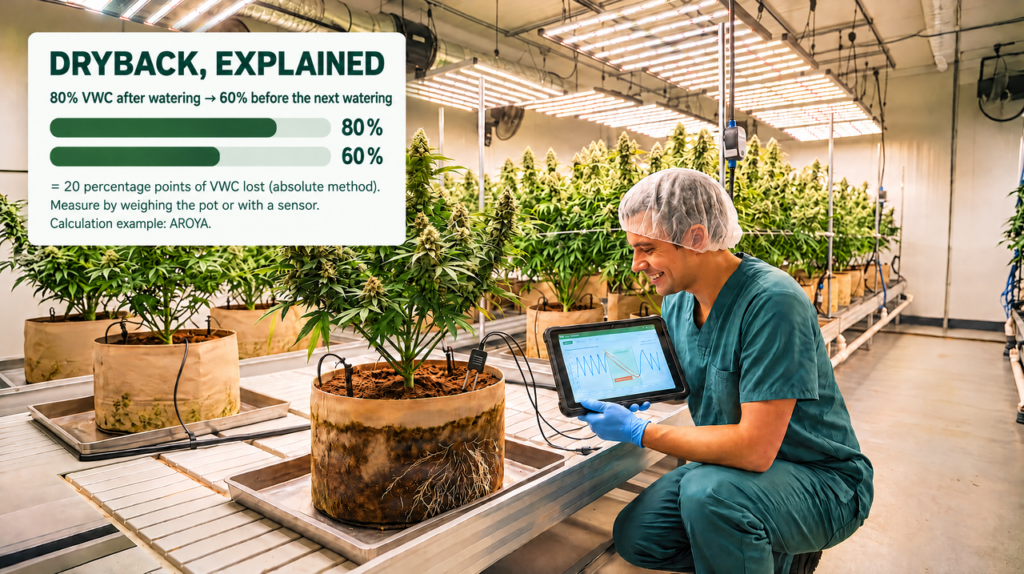
"Dryback" refers to the decrease in the substrate's water content between waterings or overnight. To measure it, we usevolumetric watercontent, often abbreviatedas VWC: the percentage of the substrate's volume occupied by water.
The calculation is simple. If the substrate is at 80% of field capacity immediately after watering and drops to 60% before the next watering, the dryback is 20% (AROYA).
Please note that there are two calculation methods:
- The definitive method: simply subtract the two values. From 50% to 20% of VWC, the dryback is 30%.
- The relative method: The loss is expressed as a percentage of the maximum moisture content. From 50% to 20%, 60% of the available water has been lost.
Both approaches are valid, but they yield very different numbers. Before following a recommendation, always check which method was used.
Why Dryback Is So Important
A constantly waterlogged growing medium is not good for the plant. By allowing the growing medium to dry out partially, the dryback plays several essential roles.
- It oxygenates the roots. As the water drains away, air fills the pores of the growing medium. The roots can breathe more easily, which stimulates their growth and activity.
- It encourages the roots to explore. A slightly dry growing medium prompts the root system to branch out in search of water, resulting in a denser, more vigorous root ball.
- It improves nutrient absorption. Regularly alternating between watering and drying helps renew the nutrient solution around the roots.
- It helps prevent diseases. Excess moisture promotes root rot, fungi, and soil gnats.
- It acts as a signal to the plant. This is its most subtle role: depending on the extent of the dryback, the plant directs its energy toward the foliage or toward the flowers.
Conversely, excessive dryback leads to undue stress: wilting, salt accumulation in the growing medium, and root burn.
Dryback and crop steering: guiding the plant
Crop steering, or “crop management,” involves directing the plant toward vegetative growth (leaves and stems) or generative growth (flowers and resin) by adjusting the moisture and salinity (EC) of the growing medium. Dryback is the primary factor in this process: mild, regular drybacks promote vegetative growth, while more pronounced drybacks promote flowering (Hydrobuilder).
| Vegetative Growth | Generative Approach | |
|---|---|---|
| Objective | Promote foliage growth, plant structure, stems, and head size | Promote the development of flowering parts, resin, and aromas |
| Dryback | Low and steady | Most importantly, especially at night |
| Water Content | Higher | Lower |
| EC of the substrate | Lower | Higher |
| Watering | Start early, small and frequent | They start later, with fewer people and larger portions |
A traditional strategy alternates between the two depending on the stage of cultivation. During the growth phase, the focus remains on vegetative growth. At the start of flowering, during the elongation phase, the focus shifts to generative growth to limit elongation and increase the number of flowering sites. During flower swelling, the focus often returns to vegetative growth to support volume increase (Dankum).
The Four Phases of a Day's Watering
In crop steering, the irrigation day is divided into four phases, labeled P0 through P3 (Randy Wintle).
| Phase | Moment | What's Going On |
|---|---|---|
| P0 | Turning on the lights until the first watering | The plant starts to transpire again, and the growing medium continues to dry out |
| P1 | First waterings of the day | Successive small doses restore the substrate to its maximum water-holding capacity, until drainage occurs |
| P2 | Remaining time in the lit period | Maintenance irrigation maintains soil moisture levels and controls daytime dryback |
| P3 | From the last watering to when the lights come back on | Nighttime dryback, one of the most powerful tools in crop steering |
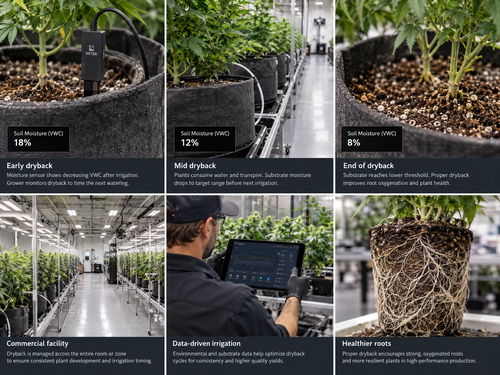
Nighttime dryback is particularly crucial. When more pronounced, it directs the plant toward flowering; when milder, it maintains vegetative growth. As a general guideline, a nighttime dryback of about 5 to 8 percent is recommended for promoting vegetative growth in rock wool (Hydrobuilder).
Measuring and Controlling Your Dryback
You can't manage without measuring. Farmers have two main methods at their disposal.
Weighing the pots. This is the most accessible method: weigh the pot right after watering and then again before the next watering. The difference in weight represents the water lost. Simple and inexpensive, this method is only approximate but is more than sufficient for hobbyist gardening.
Substrate sensors. Placed in the pot or growing block, they continuously measure moisture content and often EC. They allow for precise, hour-by-hour monitoring of dryback and enable automated watering. They are the standard tool in professional cultivation.
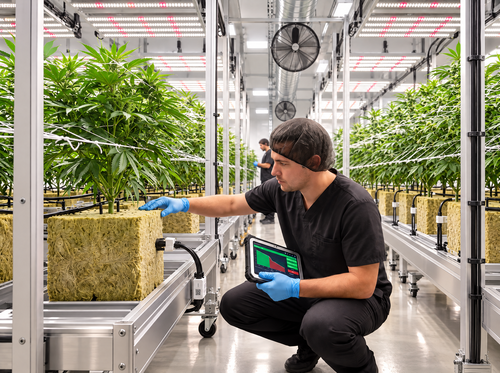
The behavior of dryback also depends heavily on the substrate:
| Substrate | Responsiveness | Dryback Control |
|---|---|---|
| Rock wool | Inert and highly reactive | Highly precise, ideal for short, frequent waterings |
| Coconut fiber | The more dazed she is, the slower she reacts | Accurate, but it takes longer for the adjustments to take effect |
| Soil and potting mix | High retention, slow reaction | A more general approach: we mainly think in terms of watering and drying cycles |
As a general guideline, professional hydroponic systems often aim for a moisture content of 60 to 75% in rockwool and 55 to 70% in coconut coir during the day (Hydrobuilder). These figures vary depending on the growing medium, climate, and strain: the key is to monitor the trend rather than aim for a fixed value. It is essential to carefully analyze the interplay and how these values change within your cannabis grow using the highest-quality feminized seeds, in order to optimally adjust your overall growing parameters.
Mistakes to Avoid
- Watering out of habit. Watering every day at a set time, without considering how dry the soil actually is, prevents dryback and suffocates the roots.
- Taking dryback too far. Excessive water stress causes the plant to wilt, concentrates salts in the growing medium, and can burn the roots.
- A sudden change in strategy. Switching abruptly from light drybacks to very pronounced drybacks shocks the plant. Adjustments must be made gradually.
- Confusing calculation methods. A 30% dryback in absolute terms has nothing to do with 30% in relative terms.
- Ignoring environmental factors. Temperature, humidity, and light intensity affect perspiration, and therefore drying speed. The same strategy will not produce the same dryback in summer as it does in winter.
- Do not copy the numbers without adapting them. The published values are guidelines, not rules. Each substrate, each setup, and each variety reacts differently.
Conclusion
Dryback is about much more than just watering. By allowing the growing medium to breathe between waterings, it keeps the roots healthy, improves nutrient absorption, and—in expert hands—becomes a powerful tool for significantly guiding the plant toward vegetative growth or flowering.
That said, you don’t need to equip yourself like a pro to take advantage of it. Simply weighing your pots, observing your plants, and making gradual adjustments is enough to make a real difference. Sensors and automation can come later, for those who want to take things a step further technically.
Reminder: Growing cannabis that contains THC is prohibited in France and in many other countries. This article is provided for informational purposes only; please check the laws in effect where you live.