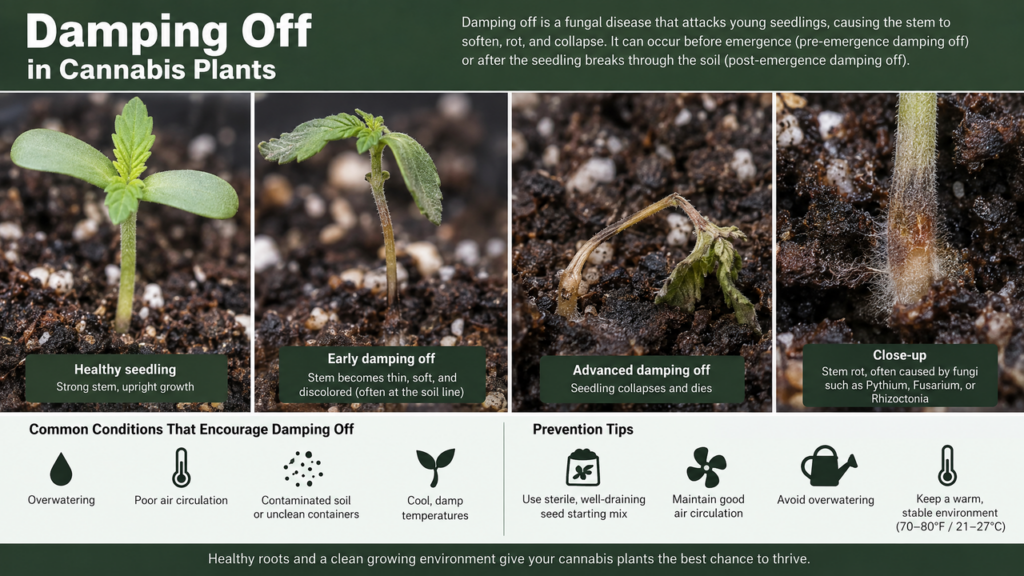
You've sown your seeds with care, your feminized seeds germinated went well, the first leaves are peeking out… and overnight, your young seedlings have fallen over, their stems snapped at the soil line. This scenario, as frustrating as it is common, has a name: damping off. And in most cases, the culprit is Pythium.
In this article, we explain what this pathogen actually is, how to identify it, under what conditions it thrives, and, most importantly, how to protect your seedlings in the long term.
What is seedling rot?
Damping-off refers to the group of diseases that cause very young plants to rot and collapse before or shortly after they emerge. It affects virtually all cultivated species: vegetables, flowers, herbs, ornamental plants… and, of course, cannabis, whose seedlings are particularly vulnerable during their first two or three weeks.
Several pathogens can cause this disease, including Pythium, Rhizoctonia, Fusarium, and Phytophthora. Among them, Pythium is one of the most common and most destructive, particularly in damp, poorly drained environments.
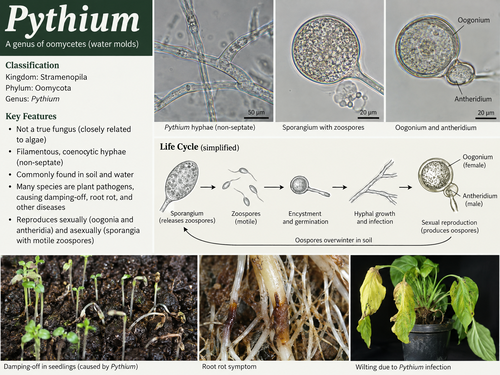
Pythium: a “fungus” that isn’t quite one
Pythium is commonly described as a fungus, and the term has become widely accepted. Scientifically speaking, however, it is important to clarify that Pythium belongs to the group of oomycetes, often called “watermolds.” These organisms resemble fungi in their lifestyle and the damage they cause, but biologically they are very different, being closer to certain algae than to true fungi.
This distinction is not merely a laboratory nuance: it explains why many conventional fungicides are ineffective against Pythium, which has a different biology and different metabolic targets.
Key Characteristics of Pythium
- It naturally occurs in soil, substrates, and irrigation water, in the form of filaments (mycelium) and survival structures called oospores
- These oospores can survive for several years in the soil, in plant debris, or on surfaces that have not been thoroughly cleaned, waiting for favorable conditions
- It produces zoospores—small, motile cells capable of swimming through free-flowing water to reach roots—which explains its rapid spread in environments saturated with moisture
- There are several species (P. ultimum, P. aphanidermatum, P. irregulare, P. myriotylum…), some of which prefer cool conditions, while others prefer warmer temperatures
The two forms of the disease
Pre-cast concrete
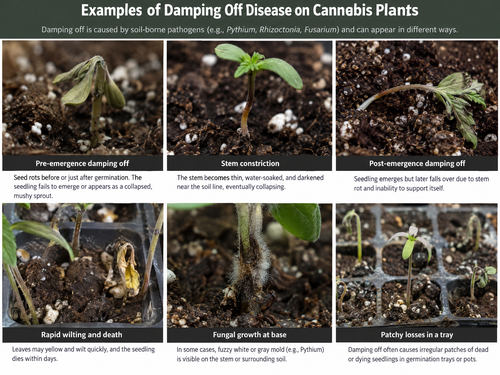
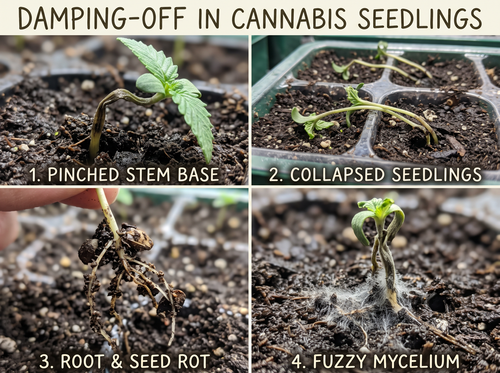
Pythium attacks cannabis seeds or the radicle even before emergence. As a result, the seed rots in the growing medium and never breaks through the soil. This phenomenon is often mistakenly attributed to poor-quality seeds or failed germination.
Post-rising melting
The seedling normally emerges, then wilts within a few hours or a few days. Typical symptoms include the following:
- A stem that tapers and narrows at the collar, at the base of the plant, giving the appearance of being constricted
- A brown, translucent, or “waterlogged” area that feels soft to the touch
- A seedling that lies flat on the growing medium even though its leaves still appear green
- Brown, softened roots, sometimes lacking their outer sheath, which comes off easily (“sock-thread roots”)
- Rapid spread: Entire areas of crops can be wiped out within 24 to 48 hours
Under what conditions does Pythium grow?
Pythium is, above all, an opportunistic pathogen: it thrives when conditions are favorable to the pathogen and unfavorable to the plant. The main risk factors are:
- Excess moisture: constantly soggy soil, overwatering, poor drainage
- A lack of oxygen at the roots, which weakens young plants and promotes infection
- Inappropriate temperatures: Some species thrive in cool environments (around 15 to 20 °C), while others thrive in warm environments (above 28 °C)
- Stagnant air, which keeps surface humidity high
- Contaminated growing medium or containers: reused potting soil, poorly cleaned pots, unsterilized tools
- Contaminated irrigation water, particularly in stagnant reservoirs or closed systems
- Overly dense planting and excessive nitrogen fertilization, which make the plant tissues tender and vulnerable
In hydroponic or recirculating systems, Pythium is responsible for the well-known root rot, which is exacerbated by water that is too warm (above 22 °C) and low levels of dissolved oxygen.
How can you distinguish Pythium from other causes of damping-off?
A visual diagnosis is never completely reliable, but there are a few clues that can guide the analysis:
| Agent | Typical signs |
|---|---|
| Pythium | Stem saturated with water, excessive moisture, brown and soft roots, very rapid progression |
| Rhizoctonia | Drier, reddish-brown lesions; sometimes a fine layer of mycelium is visible; less saturated conditions |
| Fusarium | Browning of conductive tissues, gradual wilting, often associated with warmer temperatures |
| Phytophthora | Symptoms similar to those caused by Pythium, often occurring under very humid conditions and at a later stage |
For absolute certainty, a laboratory test remains the only reliable method, especially if the losses are recurring.
Preventing Seedling Blight: The Best Strategy
When it comes to Pythium, prevention is far more effective than treatment. Here are the best practices to follow starting at the time of sowing.
1. Start on a Solid Foundation
- Use a new, high-quality, well-draining growing medium, possibly mixed with perlite or vermiculite
- Never reuse potting soil that has previously contained diseased plants
- Thoroughly clean and disinfect jars, trays, tools, and work surfaces before each new cycle
2. Managing Watering
This is the most critical point. A substrate that is constantly saturated is the pathogen’s best ally.
- Water sparingly and only when the surface begins to dry out
- Let the soil breathe between waterings
- Make sure the containers drain properly, with no standing water in the saucers
- Use clean water at room temperature
3. Protecting the Climate
- Maintain a stable and appropriate temperature, generally between 22 and 26 °C for seedlings
- Ensure good air circulation using a low-speed fan to prevent moisture from building up
- Avoid leaving the proofing boxes closed for too long once the dough has risen
- Do not plant the seedlings too close together
4. Strengthen the seedlings rather than force them
Vigorous seedlings are more resilient. Avoid over-fertilizing with nitrogen during the very first few weeks, and prioritize steady growth over rapid growth.
5. Rely on biological control agents
Several beneficial microorganisms are known for their ability to limit the growth of Pythium, either through competition or antagonism:
- Certain strains of Trichoderma (T. harzianum, T. asperellum, etc.)
- Bacteria of the genus Bacillus (B. subtilis, B. amyloliquefaciens)
- Some actinomycetes, such as Streptomyces
- Mycorrhizae, which strengthen the root system and the plant's overall resistance
These products are generally applied as a preventive measure, either at planting or during the first few waterings. They do not replace good farming practices, but they are an excellent complement to them.
What should you do if Pythium is already present?
Let's be clear: a seedling whose stem has already collapsed and been constricted is, in the vast majority of cases, beyond saving. It's best not to waste time on these plants.
If you notice a fire starting, here's what to do:
- Immediately remove affected plants, along with the soil surrounding them, and dispose of them outside the growing area (do not compost them on site)
- Stop overwatering and let the surface of the growing medium dry out
- Increase ventilation and check the temperature
- Isolate the plants that are still healthy and closely monitor their progress
- Thoroughly disinfect containers, tools, and surfaces before each use
- If necessary, apply an organic treatment to the remaining plants as a preventive measure
In hydroponics, it is also important to check the temperature of the nutrient solution, its oxygen levels, and the cleanliness of the reservoir—and even to drain and disinfect the entire system.
With regard to chemical treatments, their availability and legality vary greatly from country to country and from crop to crop. For cannabis in particular, the use of pesticides is highly regulated—or even prohibited—and leaves undesirable residues on a product intended for consumption. This further underscores the importance of prioritizing prevention and organic solutions.
The Most Common Mistakes to Avoid
- Watering a substrate that is still moist “just to be safe”
- Reusing Old Potting Soil Without Replacing It
- Leave the trays in a confined space with no air circulation
- Failing to disinfect pots, trays, and tools between crops
- Applying too much fertilizer to very young plants
- Sowing too densely, which promotes the rapid spread of the pathogen
In summary
Pythium-caused seedling blight is one of the worst nightmares for gardeners and growers, but it is also one of the most preventable. This pathogen only takes hold when conditions are right: overly moist growing media, a lack of oxygen, improperly disinfected equipment, or unsuitable weather conditions.
By taking care of your growing medium, managing watering, ensuring proper ventilation, and strengthening your seedlings with biological control agents, you’ll significantly reduce the risk of losing your seedlings. And if the damage has already been done, act quickly: remove the affected plants, disinfect the area, and start over on a solid foundation—after all, Pythium only has power over those who give it free rein.