- Viruses are a topic that dominates the news more than ever, certainly because the coronavirus has upended society and countless lives over the past two years.
- They are becoming increasingly prevalent in our environment, and they are having a lasting impact on more and more living organisms around the world. Plants in general, such as cannabis, are also affected by a wide variety of phytoviruses.
- In this article, we explain the latest findings regarding these phytoviruses, even though many mysteries still surround these strange, devastating modern-day pests.
- Viruses and the cannabis plant
- Vectors that facilitate the spread of phytoviruses
- The Tobacco Mosaic Virus in Cannabis Cultivation
- The Various Viruses That Harm the Cannabis Plant
- Prevention and Treatment Measures for Cannabis Viruses
Viruses and the cannabis plant
Generally speaking, phytoviruses are, by definition, viruses that infect plant organisms. More specifically, they are intracellular parasites that require a host organism to reproduce. It is worth noting that, even today, the overall level of scientific knowledge regarding phytoviruses is far less extensive than that regarding the animal kingdom.
This makes sense, after all, since it is certainly a better indicator of the symptoms that could arise in humans. However, various viruses are now clearly identified as harmful to cannabis plants with high THC or CBD content grown from “seeds,” as these viruses can cause serious problems, jeopardizing the harvest.
Although the origin of these viruses remains unexplained at this time, the scientific community has put forward three theoretical hypotheses to explain their origins. The first is a regressive hypothesis, which clearly implies that these viruses originated from microscopic cells that infected larger cells and lost part of their genetic makeup as they evolved.
The second hypothesis can be explained by a cellular origin theory, which suggests that viruses formed from different parts of the DNA and RNA of larger organisms. The third and final hypothesis is that of coevolution, which explains that viruses are composed of protein molecules and nucleic acids.
The tobacco mosaic virus (TMV), or Tobacco Mosaic Virus, was the first of its kind to be discovered by Adolf Mayer in 1886. It was not until 1898 that Martinus Beijerinck was able to replicate the experiments previously conducted by Dimitri Ivanovsky in 1892.
He used the term “virus” for the first time at that point to describe the symptoms of the tobacco mosaic virus. To him, it was therefore clear that the cause of this disease was neither a fungus nor a bacterium.
The majority of identified phytoviruses specifically infect certain plant species, which clearly indicates that they require at least one specific type of host cell to reproduce, thereby limiting their potential infections to a limited number of species.
In any case, we are witnessing the emergence in the natural environment of a multitude of viruses capable of causing serious problems for a wide range of agricultural species, which is giving farmers around the world quite a scare.
Vectors that facilitate the spread of phytoviruses
According to certain scientific observations, it appears that phytoviruses are essentially protein capsules containing a portion of genetic material; the missing part prevents them from moving from one plant to another. This naturally raises the question: how, then, are they able to cause so much damage to a crop?
In fact, their spread is facilitated by the presence of various viral vectors—more specifically, living organisms that carry these viral particles from a plant infected with the disease to another healthy plant, ultimately helping the virus to establish itself in new host cells.
Most of the time, it is parasitic or harmful insects that affect cannabis—such as aphids, scale insects, nematodes, spider mites, thrips, and whiteflies—that act as direct viral vectors. Without realizing it, growers themselves play a role in transmission by closely tending to and caring for cannabis plants grown from seeds with high THC or CBD content.
The Tobacco Mosaic Virus in Cannabis Cultivation
The tobacco mosaic virus is, as its name suggests, a viral disease that is particularly harmful to the tobacco plant, although it can infect more than 125 species across 9 different plant families. However, many growers remain skeptical and are seeking definitive answers as to exactly how the tobacco mosaic virus infects cannabis.
It is still worth keeping in mind that a virus can sometimes be identified by a specific acronym, even though it is actually a different strain associated with another viral phenomenon (such as the hemp mosaic virus (MHV), which is actually the cowpeastrain of thetobacco mosaic virus).
The VMT capsid consists of at least 2,000 protein molecules that form a shell and a single-stranded RNA molecule. Unlike many other viral phenomena, once this virus enters the host cell, its protein capsid detaches from the rest of the virus, releases the viral RNA, and begins to replicate its own genome.
The disease causes various symptoms in plants within the crop; we can observe significant discoloration between the veins of the youngest leaves, which must not be confused with symptoms of nutrient deficiency. These color changes are accompanied by the development of mosaic-like spots with varying light and dark patterns. It is also possible to see the leaves wilt, eventually becoming rough to the touch.
The lower parts of the marijuana plant are also affected, especially if the weather isn’t on our side—which, more specifically, means if we have hot temperatures and dry conditions. You may also notice necrotic damage to the leaves, leading to a general slowdown in growth or flowering in plants grown from seeds with high THC or CBD content.
VMT, or TMV (Tobacco Mosaic Virus), is certainly one of the most stable phytoviruses in existence. As long as the ambient temperature does not fall below 4°C, the virus remains perfectly stable. A crop grown in greenhouses or located within a botanical garden provides ideal conditions for its reproduction, thanks to the high and stable temperatures there, as well as the very wide variety of plants stored in that location.
The Various Viruses That Harm the Cannabis Plant
Cannabis plants with high THC or CBD content are potentially susceptible to VMT, as well as to many other phytoviruses, some of which have not yet been clearly identified. Fortunately, most of these phytoviruses do not affect only cannabis; they also ravage many other plant families and species.
We might add that plants can be infected by several viruses at once, which makes it very difficult for growers to distinguish between these different viral conditions. Growers must adapt to the specific characteristics of each viral condition—such as a disease—and apply the most appropriate treatment for it.
It appears that nearly 900 phytoviruses have now been identified, but there is still a long way to go in terms of scientific research, as only a small number of them have been the subject of sufficiently in-depth and well-documented studies. Currently, only two viruses are clearly identified as particularly harmful to cannabis.
These are the hemp mosaic virus (HMV) and the hemp streak virus (HSV). These two viral diseases specifically affect cannabis plants through the action of viral vectors such as aphids, caterpillars, thrips, and spider mites.
Some studies by the scientific community have also shown that the tobacco ringspot virus (TRSV) and the tobacco streak virus (TSV) are also capable of causing such an infection, resulting in symptoms similar to those caused by the VMT.
It’s exactly the same with the alfalfa mosaic virus. Strangely enough, they all primarily use seeds and aphids as vectors for these parasitic diseases. The arabidopsis mosaic virus (ArMV) also appears to be capable of wreaking havoc on cannabis plants via nematodes and seeds, though asymptomatically.
The cucumber mosaic virus (CMV) affects both cucumber and marijuana plants, once again due to the active involvement of aphids or seeds as viral vectors. To conclude this section, it appears that the tomato ring spot virus (TomRSV) also uses cannabis as a host plant.
There is also a viroid that originates in hops, which is quite virulent and severely affects cannabis plants. The Hops Latent Viroid (HpLVd), which first appeared in the United States several years ago, has become a serious problem for many professional growers in the U.S. in recent years.
A prestigious California “nursery” sold numerous infected clones to many companies in the industry there, and the vast majority of growers were slow to realize what was happening in their crops. This viroid actually produces rather misleading symptoms, as the foliage exhibits signs similar to nutrient deficiencies, and the plants’ growth or flowering slows down abruptly, leading growers to be misled, even as the disease takes hold permanently.
This viral phenomenon may be asymptomatic for a certain period of time, after which symptoms may appear suddenly. This can lead to a significant loss of certain genetic traits, and we are seeing a significant decline in both flower and cannabinoid production at the same time.
Prevention and Treatment Measures for Cannabis Viruses
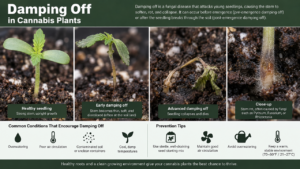
Unfortunately, as with certain fungal diseases caused by parasitic fungi that affect plants, there is not yet a suitable treatment that can completely and quickly eliminate the infection or the adverse effects of phytoviruses affecting indoor and outdoor cannabis cultivation.
As with many diseases caused by parasitic fungi such as Botrytis, downy mildew, powdery mildew, Alternaria, Fusarium, or leaf Septoria—whose symptoms are often characterized by the appearance of rot—it is necessary to implement a series of preventive measures.
It is essential for growers to thoroughly clean their indoor cannabis grow space, from floor to ceiling, by picking up all leaves and plant debris lying around. It is crucial to always try to maintain a stable temperature when growing indoors. Also, try to ensure good air circulation—such as even ventilation—to prevent the buildup of stagnant air pockets, which are harmful. A key factor here is maintaining a stable humidity level without excessive fluctuations.
Keep in mind that leaves provide an ideal habitat for the development of the rot characteristic of these parasitic fungi. Unfavorable environmental conditions can trigger these fungal issues. Be sure to water your plants with precision, using an amount of water and nutrients appropriate for the stage of growth. Generally, cannabis plants require little water during the last two weeks of flowering. You need to be careful at this stage, as it’s the perfect time for a fungus like Botrytis to appear.
You must be vigilant about poor control of environmental parameters, as this can facilitate the onset of fungal diseases such as Fusarium, which attacks the roots and is particularly difficult to eradicate. This may seem obvious, but we want to warn you that consuming cannabis flowers infected with fungi is dangerous to your health. It can cause serious respiratory problems in humans, so it’s best to refrain from doing so and avoid it altogether.
But that’s not all—growing under such conditions could also easily lead to an infestation of pests, which could become a secondary problem and thus jeopardize your harvest’s chances of success. A key factor lies, above all, in choosing the highest-quality cannabis seed varieties to purchase.
It is very important to select varieties that are as resistant as possible to all of these pests and diseases, and whose characteristics are suited to the climatic conditions of your geographic area. Indoors, climate control is of the utmost importance; air exchange and precise humidity control must be given the highest priority.
Apply a root stimulator once a week, as this will help produce strong, healthy roots with excellent absorption capacity. Root health is very important because it directly helps strengthen the immune system of your marijuana plants.
We can conclude that these viral phenomena are a modern-day scourge of our time, shrouded in many mysteries, which we hope will be unraveled in the years to come. This shows us that chemicals do not seem to be as revolutionary as they appeared to be just two decades ago. Nature will continue to teach us many life lessons in the future.