- Choosing the right pot for growing cannabis may seem like a no-brainer at first glance, but there are some nuances to consider that will be crucial to ensuring everything goes smoothly in the coming weeks.
- It is important to choose the right type, size, and color of pots for growing cannabis.
- Even though this is a topic that most growers seem to know inside and out, in this article we’ll explain how to choose a pot for growing cannabis.
Choosing the right pot for growing cannabis is more complex than it seems, as there are a number of key criteria that must be taken into account in order to maximize your crop’s potential. An autoflowering variety has structural characteristics that differ from those of photoperiod varieties available as feminized seeds, for example. They therefore each have different needs in this regard.
There are a multitude of factors to consider, depending on whether you want to grow indoors or outdoors, the layout of your growing space, the method you use, and your ultimate goal. It’s true that choosing the right soil mix—or potting mix and fertilizers—is essential, but that’s not all, because the pot will be the home where our dream plant grows for weeks on end. It’s therefore best to place it in an environment that provides optimal and comfortable conditions.
There are so many different types of containers that it can be helpful to get some guidance. Capacity (in liters) is an important factor, as is the number of drainage holes; the color of the container may also be a factor worth considering, depending on the intensity of the sun in certain parts of the world.
In the rest of the article below, we’ll use several different cannabis-growing scenarios to explain which type and size of pot is best suited to help you achieve the best possible results in terms of both quality and quantity.
The best pots for growing cannabis in a grow tent (1 m²)
To successfully start a grow using feminized cannabis seeds in a space equivalent to1 square meter, you must first germinate the seeds using an appropriate method. Once this step is complete—that is, after a period of 2 to 10 days—you will need to transplant your young seedlings into individual pots with a capacity of 3 to 4 liters for the growing phase. We generally recommend a 3-week vegetative period for most photoperiodic varieties.
For the flowering stage, we recommend 7L or 11L square pots, depending on whether you want to fit more or fewer plants in your grow space. The square shape of the pot helps you make the most of every square inch indoors. The extra space in this new type of pot will give your plants a nice boost of energy, since they’ll be able to take advantage of a growing medium with twice the capacity.
This available space allows us to anticipate optimal conditions for both root development and plant growth during the upcoming weeks of flowering. You can ultimately choose to place either 8 to 10 plants in 7-liter pots or 5 to 6 plants in 11-liter pots in your 1m² grow space( equivalent to a 100x100x200 cm grow tent), depending on your preference.
If you have bigger plans, you can also opt for a 1.20 m² grow tent( 120 x 120 x 200 cm); this size is becoming increasingly popular among serious growers because it offers greater production capacity. In this setup, you can fit 10 to 12 plants in 7-liter pots, or 7 to 8 plants in 11-liter pots.
You may also be limited by the size of your space, which is why a 0.80m² grow tent( 80x80x160 cm) might be a good fit. This will allow you to easily fit about ten cannabis plants inside, in 4-liter pots.
However, it will be essential to choose seeds from a variety that remains compact during the flowering period. You can also opt for an autoflowering variety or a CBD plant, but you’ll need to carefully review their characteristics first to be sure.
The best pot for growing a cannabis seed outdoors or on a balcony
We recommend that anyone planning to grow cannabis outdoors—whether in a garden or on a patio—opt for white pots rather than black ones, in order to minimize the impact of intense sunlight on the growing medium inside the pot.
Depending on your geographic location, the intensity of the sun varies; there are parts of the world where temperatures are very high (over 40°C). Using black materials under such conditions would further increase the heat in the soil and would be disastrous for virtually all types of cannabis strains.
Whenever possible—and within your budget—we recommend using geotextile pots with a capacity of at least 20 to 30 liters for outdoor gardening, as they offer numerous benefits. This type of pot provides excellent aeration for your soil, which is important for accelerating the plant’s various metabolic processes, as well as for the soil’s microbial life—especially for those who grow using organic methods.
They also help prevent excessive heat from building up in the soil. At the same time, these conditions are ideal for the development and health of each plant’s root system. This will help you achieve a good final yield.
It is also possible that some growers may wish to grow several plants at once while maintaining a degree of privacy from those around them. They have three options: the first is to choose feminized cannabis seeds from a compact, Indica-dominant strain, or to opt for high-quality, productive autoflowering strains such as Moby Dick Auto, Critical+2.0 Auto, Critical Jack Auto or L.A. Vanilla Cake Auto.
We also recommend applying a layer of mulch to the surface of your potting mix to reduce water evaporation and moderate soil temperature; adjust the thickness of the mulch layer according to the heat levels in the region where you are growing your plants. This will also protect the microbial life present in the soil.
Naturally, you’ll need to ensure that the plants receive an adequate amount of light and water containing fertilizers rich in complete nutrients, in proportion to the climatic conditions, while also ensuring proper air circulation around the plants on the site. To grow discreetly, we recommend choosing a smaller pot, opting for one with a maximum capacity of 4 liters. The roots may suffer a bit from being slightly cramped after a while, but at least you’ll achieve the goal you’ve set for yourself.
The perfect pots for growing autoflowering seeds in a1-square-meter grow tent
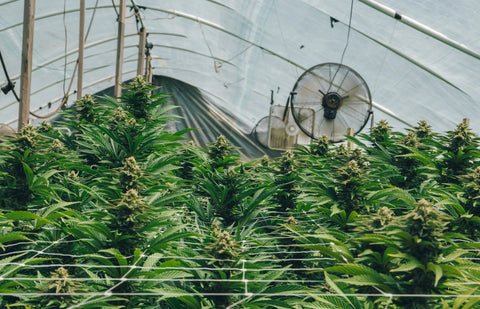
To grow cannabis plants from autoflowering seeds in a 1m² space, we recommend using pots—preferably white plastic or geotextile—with a capacity of 7 to 11 liters, which you will use throughout the entire growing cycle without needing to repot at any point. This will be the only container used for each plant throughout the entire cycle.
The different sizes of these pots represent the two best options available to you in this regard, both in terms of the total number of plants you can fit into a grow tent of this size and the final yield you can expect from each plant.
You can fit between 8 and 9 plants in this space while maintaining comfortable growing conditions. We believe this is the best solution for growing autoflowering plants indoors.
The best pots for growing autoflowering cannabis plants outdoors
When growing this type of plant on your patio or in your garden—or simply outdoors—we recommend choosing fairly large pots, ranging from 15 to 30 liters, depending on the desired final size of the plants.
If your balcony will be their home, then choose a pot size of about 7 to 11 liters. This size is ideal for ensuring a good yield while effectively controlling the growth of each plant. You’ll just need to add the right amount of soil without packing it down too much, as this type of plant requires a well-aerated growing medium to ensure the soil is well-oxygenated, which accelerates growth and development—as well as overall metabolic processes—and ultimately prevents any issues.
Of course, it will be necessary to carefully adjust the watering regimen, providing the right amount of water, fertilizer, and all the nutrients required for each stage of the plant’s growth.