- When you're just starting out in cannabis cultivation, everything seems complicated as you begin to explore the various aspects of this activity, because it's necessary to have some basic knowledge.
- Even fairly simple things—like choosing the right potting soil, fertilizer, and pots, for example—aren't easy for someone who has never gardened before.
- That’s why today we’re taking a look at a topic that may seem basic but still requires a certain approach and a certain degree of precision—namely, how to water a cannabis plant.
It’s quite likely that some of you think this aspect of growing cannabis isn’t particularly difficult and that watering a cannabis plant is certainly the easiest thing to do. In reality, it’s not quite that simple, and it’s best to familiarize yourself with a few key points in order to maximize the potential of the cannabis seeds you’ve purchased.
It’s important to realize that this factor will have a direct impact on both the quantity and quality of your harvest. One basic question that comes up quite often is that beginner growers, like my friend Jerome, wonder how much water and fertilizer to use when watering their cannabis plants.
It is important to note that this depends on the region’s climate conditions, the type of growing medium and pot used, the size of the pot, and the specific needs of the hybrid being grown. These are a combination of factors that must be given the utmost consideration in order to achieve a bountiful harvest of the highest quality.
Weather Conditions
The climate is certainly the factor that will have the greatest influence on how often you’ll need to water your plants. Whether you’re growing indoors or outdoors, it’s essential to adapt your equipment, tools, and other aspects of your exciting hobby to the climate in which you’ll be working. It’s important to anticipate problems by staying informed about specific weather conditions so you can best prepare for both planting and outdoor growth.
You’ll need to learn how to manage environmental conditions—including light intensity, temperature, and humidity—both indoors and outdoors. Imagine you’re starting your “outdoor” season by planting your cannabis plants a little too early in the season, when it’s still cold and rain is still frequent—at the end of winter, for example.
In this specific case, you have the ideal conditions for slowed growth, with a fairly high probability that fungal diseases and pests will attack your precious cannabis plants fairly quickly. To put it simply, this is where the problems begin…
For all these reasons, it is essential to be well-informed about the temperature and humidity levels—both day and night—in the geographic area where you are growing your plants. These two factors will give you an idea of the climatic conditions your plants will face at a specific time of year, in addition to various other indicators that we’ll explain below.
If you’re growing plants in an environment where the temperature is consistently high, you’ll need to consider adding mulch to the surface of the growing medium, as well as a certain amount of perlite on top of the soil, or mixing the perlite directly into your potting mix.
These components protect your plants from the heat because they significantly help the potting mix retain moisture; they also limit evaporation and regulate the soil temperature at the same time.
The ultimate benefit of this practice is that it helps significantly reduce the frequency of each watering, as well as the associated water stress. The goal is to optimize your water use—which is of paramount ecological importance today—while also maintaining a healthy balance for your plant roots.
It’s important to provide your plants with the best possible conditions so they can absorb all the nutrients they need until harvest. Be sure to refresh the canopy of your cannabis plants by misting them with water during the growing phase, while taking care to avoid leaving large drops on them, as this could cause leaf burn. Also, be sure to provide them with the appropriate amount of nutrients for each stage of the plant’s development; this will optimize their potential and strengthen their immune system at the same time.
Learn how to accurately assess and remember the watering needs of each of your cannabis plants. It’s very simple: manually weigh a pot filled with dry soil, and then weigh the same pot with soil that’s been watered—using exactly the same amount of water as you would when watering your cannabis plants—and make sure to remember the weight of the pots by lifting them by hand.
Here’s the best, safest, and most affordable tip for assessing the water needs of your cannabis plants anywhere in the world—even under the most challenging conditions. The results are quick and reliable—once you get the hang of it, you’ll never make a mistake. Some might think that an automated drip irrigation system is the best solution to avoid all watering problems, but the reality isn’t always that simple, as there are a multitude of related factors to consider.
As fall approaches—which is also harvest season—you’ll need to be aware of the opposite trend, that is, if rains are frequent and temperatures are fairly cool, you’ll need to space out your watering schedule and be on the lookout for any harmful fungi (powdery mildew, downy mildew, botrytis, etc.) that can affect many marijuana strains. Another important point is to choose your seeds carefully, ensuring they are well-suited to the climatic conditions in which they will grow.
Soil Composition
This is a very important topic, because the soil’s evaporation rate varies depending on the different components used in its composition. If you’re growing plants using a high proportion of coconut coir, for example, evaporation will occur more quickly than with a soil mix.
The use of topsoil, light peat, dark peat, or perlite is beneficial because these four materials have a high water-retention capacity, for example. The point is to help you understand that it’s important to adjust the soil composition based on the climate and the specific needs of the cannabis plant you’re growing.
An autoflowering cannabis plant will benefit from having 30% coconut fiber in its growing medium, simply because this type of plant requires a high level of oxygenation in the soil to accelerate both its metabolic processes and growth at the same time, since the growth period for an autoflowering plant lasts only about 20 days.
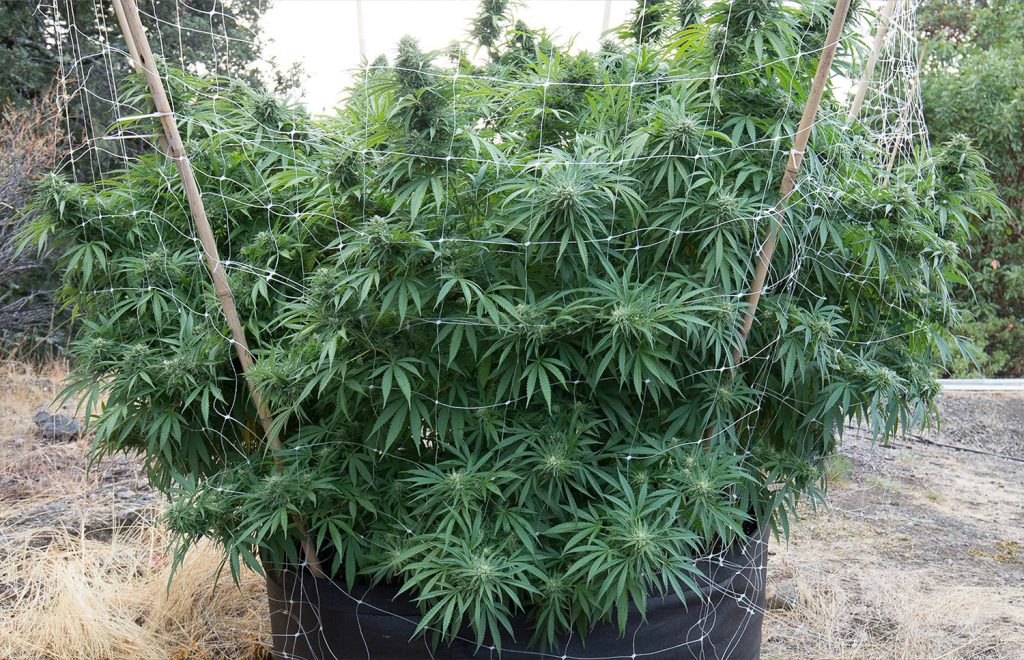
It is therefore necessary to provide the plant with as many resources as possible in the shortest amount of time to maximize its potential. For these same reasons, it may be beneficial to use pots with a capacity of 15 to 20 liters when growing autoflowering plants outdoors, since well-aerated soil and a substrate volume of this size will ensure a high-quality, maximized yield.
Unlike autoflowering strains, photoperiod cannabis varieties prefer soil with a denser, moister texture. They thrive best in a stable soil mix and are less tolerant of water shortages than autoflowering strains. It will therefore be necessary to adjust both the frequency and the amount of water and nutrients during each watering session over the course of several weeks. Also, be sure to test the pH level if you’re using tap water.
Plant size and pot capacity
These two factors are directly related, because the greater the substrate’s capacity, the more the root system can develop, and, logically, the larger the plant will be. It will also be necessary to adjust the corresponding amount of water and nutrients.
A mistake that beginners make quite often is this: if we plant a small seedling that is 1 to 3 weeks old in a large pot with a capacity of 25 to 50 liters, for example, it will have a relatively low water requirement at that point, compared to its water needs during the flowering phase a few weeks later. It’s important to know how to adapt to the situation under all circumstances.
Logic dictates that, in this specific case, it will be necessary to water infrequently during this period; a single weekly watering will certainly suffice. However, you must remain mindful of the weather conditions at the site where you are growing your plants. As each plant continues to grow and increase in size, you will obviously need to adjust the amounts of both water and nutrients accordingly.
Initially, a common mistake many growers make is that they drown the roots in water because the potting mix is so saturated; as a result, this significantly slows the growth of the cannabis plant.
This can be explained by localized root asphyxia—that is, a lack of oxygen in the soil leads to problems with water and nutrient absorption at the root level. For this very reason, the minimalist yet highly effective watering tip mentioned above proves to be a valuable aid right from the start.
However, you’ll need to be careful not to leave your roots in a substrate that’s too waterlogged for too long, because otherwise you might see a fungal disease called fusarium, which in this case is caused by root rot. The first symptoms are most often slowed growth in your cannabis plants.
The one thing you must avoid at all costs during the first 3 weeks of growth is overwatering the growing medium, as this could drastically slow down the growth of your cannabis plants. It’s essential to ensure a balance between well-moistened soil and oxygenated soil, without ever allowing it to become completely dry. Limiting the size of the plant’s structure and root development also means reducing each plant’s yield potential.
If you overwater during this period, it could also lead to a serious problem, such as a weakened immune system in the plant, or even root rot, which would ultimately result in the appearance of certain fungi and pests. This, in turn, sets off a chaotic chain reaction. It is extremely important to be meticulous about how you water; admittedly, this does require a certain learning curve.
Remember the intuitive method of manual weighing or estimating weight—I assure you it works even for large-scale container gardening. If a pot feels abnormally light for its size and contents, you can conclude that the soil is much too dry.
Conversely, if it feels excessively heavy, it means the soil is saturated with water. When the leaves droop downward, that’s a very bad sign, because it means the affected plants are in an advanced state of water stress—you need to act quickly and water them immediately!
It’s not a good idea to let the soil dry out completely, because it will take some time for the soil’s components to regain their moisture-retention and water-conducting abilities, which causes stress to the plant since it isn’t properly hydrated. And as our dear Jerome would say, that’s no small feat.
It is important to determine the proper watering frequency for each growth stage so that the plants receive the right amount of water along with all the nutrients they need to reach their full potential. These tips also apply to growing high-CBD plants from seed. Always remember to check both the temperature and the pH of your tap water, as these can vary significantly from one region to another.
It is important to always ensure that the leaves of your marijuana plants remain healthy and look good throughout the growing process, as they reveal information that is worth analyzing—such as various water and nutrient deficiencies that occur during the different phases of the plants’ growth cycle.
It will require you to demonstrate strong analytical skills week after week in order to identify areas of weakness and natural patterns. You should always keep in mind that every problem has a solution—that’s simply a fact of life. Learn to recognize the various color changes that appear on the leaves and, above all, what they indicate. Most of the time, these changes point to deficiencies or excesses in nutrients or water that your marijuana plants are experiencing.
You’ll also need to be especially vigilant as the end of the flowering period approaches, because as the ambient humidity naturally rises with the arrival of heavier rains in early September—which is also accompanied by a drop in temperatures—the risk of mold-related problems is high. It will therefore be necessary to reduce the amount of water used when watering, based on the humidity in the air from week to week at this stage.