
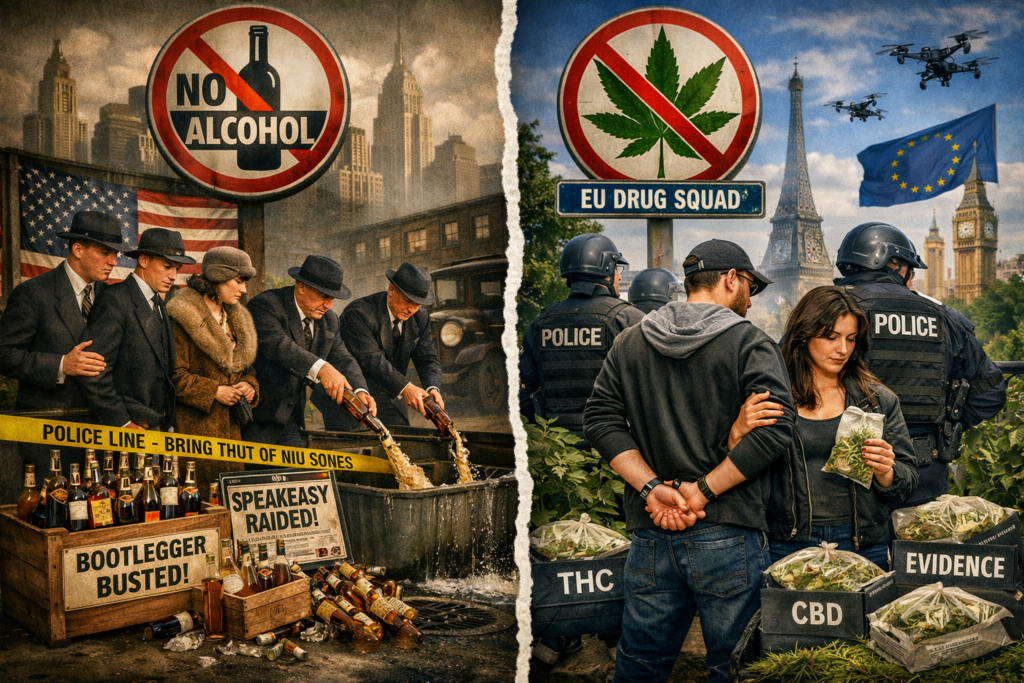
Prohibition in the United States during the 1920s and 1930s is now widely regarded as a historic failure, in terms of public health, social welfare, and public safety. Yet, a century later, many European countries still apply a similar approach to cannabis: criminal prohibition, a thriving black market, adulterated products, and profits captured by criminal drug trafficking networks rather than by the state.
Comparing these two periods raises a troubling question:Are we repeating with cannabis the same mistakes the United States made with alcohol?
1. A Look Back at Prohibition in the United States
1.1. A total ban with “noble” objectives
In the early 20th century, the United States enacted “Prohibition.” The ratification of the 18th Amendment (1920) and the passage of the Volstead Act banned the production, sale, and distribution of alcoholic beverages throughout the country.
The stated goal is twofold:
-
Reduce alcoholism, domestic violence, and alcohol-related accidents.
-
To clean up society by eliminating a product perceived as the source of many vices or excesses.
On paper, the intention seems noble: to protect the public by outright banning a substance deemed dangerous to society.
1.2. A Catastrophic Health Crisis
In practice, alcohol doesn’t disappear—it simply goes underground. Demand remains high, but supply is now controlled by illegal networks.
Health consequences:
-
The rise of “homemade” or “moonshine” alcohol, distilled under rudimentary conditions.
-
An increase in the number of adulterated beverages (containing methanol, contaminants, or diluted products) leading to blindness, severe poisoning, and death.
-
A complete lack of quality control, since the government has effectively removed itself from the market.
Prohibition, which is supposed to protect public health, ultimately exposes consumers torisks far more seriousthan those posed by legally regulated alcohol.
1.3. The Rise of the Mafia and the Criminal Economy
The ban creates a massive economic void that is immediately filled by organized crime. What was once a legal, taxed activity becomes anextremely profitable black market:
-
The emergence of organized crime syndicates (e.g., Al Capone) controlling production, transportation, and distribution.
-
Territorial wars, settling of scores, bribery of police officers, judges, and elected officials.
-
A surge in speakeasies and a parallel culture operating entirely outside official control.
The government is losing control over public health, the economy, and security.
2. The ban on cannabis in Europe: a troubling parallel
2.1. A framework that remains largely repressive
In Europe, despite some developments (medical cannabis, partial decriminalization in some countries, limited tolerance in others), cannabis remains largelyillegal:
-
Production and sale controlled by criminal networks (facilitating large-scale drug trafficking).
-
Consumers who are penalized or stigmatized/criminalized.
-
Parallel markets that evade taxation and health inspections.
The official justification here, too, is the protection of public health and the fight against addiction, particularly among young people.
2.2. Black market, adulterated products: same cause, same effects
Just as with alcohol during Prohibition,the ban did not eliminate the demand for cannabis. It simply shifted it to:
-
Resins and herbs of highly variable quality, often adulterated, poorly dried, and potentially containing mold or pathogens, or heavy metal residues.
-
Synthetic or highly concentrated products (resins with a very high THC content, synthetic cannabinoids, etc.).
-
A market where consumers have no guarantees regarding the origin, ingredients, or potency of the product.
Result:
-
Increased risk of mental health issues among vulnerable individuals, particularly when using products that are too concentrated.
-
The inability to address substance use with effective risk reduction measures (dosage, methods of use, prevention, information, and education), so that everyone can enjoy products suited to their individual needs and thus have a positive experience that aligns with each user’s specific predispositions.
Once again, the logic is the same:we impose bans, but we lose control. This global status quo, established more than 50 years ago, is gradually losing credibility among the general public.
2.3. A windfall for criminal networks
Like alcohol in the United States in the 1920s, illegal cannabis in Europe is one of the main sources of revenue for criminal organizations:
-
Cross-border importation and trafficking (Maghreb–Europe, the United Kingdom, the Balkans, etc.).
-
Violence linked to drug-dealing territories in certain neighborhoods (settling of scores, targeted killings, residents terrorized by local drug trafficking, lawless zones in certain cities, etc.)
-
Money laundering in other legitimate sectors (fast food, car rental, etc.)
Instead of a regulated, taxed, and supervised market, we are maintaining a system in whichevery euro spent by consumers bolsters mafia-like structuresrather than public services.
3. Prohibition vs. Regulation: What American History Teaches Us
3.1. Banning something does not eliminate its use
The experience of Prohibition has shown that demand for a psychoactive substance does not disappear simply because a law bans it.
On the contrary:
-
This can make the product more appealing, especially to young people (the "forbidden fruit" effect).
-
This is shifting the market toward more concentrated products that are easier to conceal and more profitable to transport (so-called "hard" drugs: cocaine, heroin, crack, fentanyl, and other synthetic drugs).
The same logic applies to cannabis: as long as there is demand, someone will comply with this request, whether it is legal or not. It is therefore easy to see that this could greatly improve both public safety and public health across all the countries that make up the European Union, so why not regulate the cannabis plant for the good of everyone? 
3.2. Prohibition = Maximizing Risks
In both cases (alcohol in the past, cannabis today), prohibition:
-
Eliminates all quality control.
-
Prevents consumers from being clearly informed about the risks and dosages.
-
Makes it impossible to conduct accurate public health monitoring (prevalence, user profiles, trends in use).
Conversely, aregulatedsystem allows for:
-
To establish standards (purity, maximum levels of certain components or active ingredients, prohibition of hazardous additives).
-
To determine sales policies (age restrictions, oversight of retail locations).
-
To allocate a portion of tax revenues to information, prevention, education, care, and research.
3.3. The Moral and Political Failure of Prohibition
When a large portion of the population continues to consume despite the ban, the law loses credibility. This is what happened with Prohibition in the United States, which was widely circumvented by people across all social classes.
The situation is similar with cannabis: in some European countries, a significant proportion of young adults have already tried cannabis, and a substantial number of them—as well as a portion of the older population—use it regularly, despite its illegality. It must be acknowledged that the vast majority of users who use it in moderation lead harmonious and perfectly balanced daily lives in various respects. Problems most often arise when cannabis use is excessive, as is the case with many substances already present in our daily lives; this is why it is essential to inform, warn, and educate the public about various risky behaviors.
That said, even today, there remains within our society a form of intense demonization of cannabis by institutions—a demonization that is entirely misplaced—due to a whole range of reasons that have absolutely nothing to do with cannabis itself, but are rather linked to social factors that are interpreted or distorted to lend credibility to the institutional theory justifying the prohibition of this plant in the eyes of the public.
This disconnect between the law and reality:
-
Undermines trust in institutions.
-
It gives the impression of hypocrisy or even deception (targeted crackdowns in certain circles, de facto tolerance in others, the alcohol industry lobbying under the guise of cultural and heritage considerations in some countries, while largely ignoring alcohol-related public health issues; the public is gradually realizing the relatively low level of danger posed by cannabis in various contexts, etc.)
-
Diverts police resources away from more serious issues that should be prioritized (serious trafficking, violent crime, etc.).
4. Why Prohibition Is Not a Good Solution for Society
4.1. From a public health perspective
In summary, prohibition:
-
Does not eliminate consumption;
-
Makes consumption more dangerous;
-
Prevents effective support (information, risk reduction, care).
Conversely, models ofcontrolled legalizationorstrict regulation (as seen in Canada, certain U.S. states, or even in European pilot projects) allow for:
-
To offer standardized, tested, and labeled products that are therefore traceable.
-
To adjust health policy (targeted campaigns, prevention efforts aimed at minors and the general public, monitoring changes in usage, etc.).
-
To curb abuses related to adulterated or highly concentrated products sold on the black market.
4.2. From an economic and security perspective
Prohibition:
-
Deprives the government of significant tax revenue.
-
Leaves billions of euros in the hands of criminal groups (drug traffickers).
-
Maintains lawless areas.
Regulation:
-
Allows for the taxation of the industry and the reinvestment of these funds into prevention, care, and education.
-
Dries up, at least to a large extent, the black market.
-
Gives the government back control over an entire sector of the underground economy. (taxation)
- Enables users to purchase products of verified quality that meet their expectations.
5. Toward a Modern Approach: Learning from Alcohol to Apply to Cannabis
The history of Prohibition in the United States serves as ahistorical warning: abruptly banning a widely consumed product does not make the problem go away, but rather turns it into something more dangerous, more violent, and harder to control.
In light of the ban on cannabis in Europe, several options are emerging:
-
Shift from a repressiveapproach to aharm-reduction approach.
-
Implement regulated systems (product quality standards, age restrictions, and oversight of sales and consumption venues).
-
Use a portion of tax revenues to fund prevention, research, and support services for problematic drug use.
-
Move the debate away from moral considerations and back to the issues of public health, safety, and the actual effectiveness of the policies implemented.
Conclusion: Prohibition—a misguided idea that must not be repeated
Prohibition in the United States was a failure:
-
The Rise of the Mafia.
-
Adulterated alcohol and health scandals.
-
Loss of trust in the government and public institutions in general.
-
An inevitable return to a regulated model in the short or medium term.
The ban on cannabis in Europe, in its current form, bears disturbing similarities to the alcohol prohibition in the United States in the 1930s: a thriving black market, unregulated products, criminal profits, and the criminalization of users rather than genuine protection of public health.
At SILENT SEEDS believe that if we want to avoid repeating the mistakes of the past, it is essential to draw on the lessons of Prohibition to develop a modern, pragmatic cannabis policy focused on harm reduction rather than on the illusion of total prohibition.