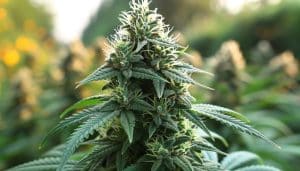
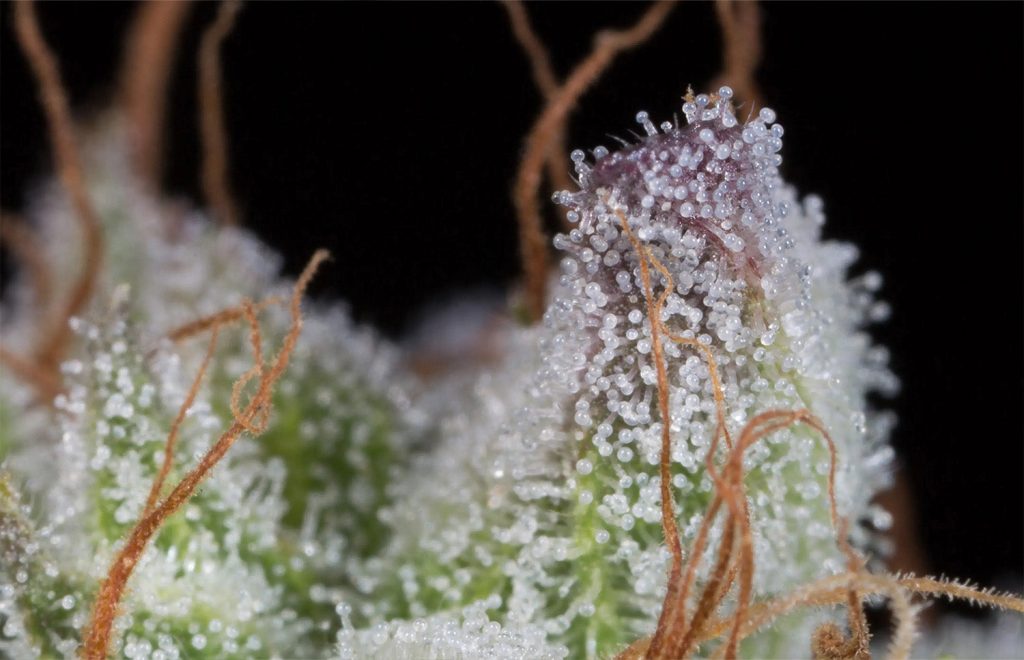
- As we explained in our first article, the terpenes in cannabis are responsible for both the plant’s aroma and flavor.
- In this second article, we’ll introduce you to the main terpenes found in the cannabis plant and describe their specific properties. Follow along!
1) Primary monoterpenes:
They are composed of two isoprene units, in other words, two blocks of five units. The best-known monoterpenes are myrcene, alpha- and beta-pinene (a-pinene and β-pinene), limonene, beta-caryophyllene (β-caryophyllene), terpinolene, and ocimene.
Myrcene:
Myrcene, or β-myrcene, is a monoterpene. It is undoubtedly the most common terpene found in the cannabis plant, as it accounts for 50% of the plant’s total essential oil production. Its aroma is characterized by a blend of earthy, musky, and grassy notes. Myrcene is a precursor to other terpenes.
A number of studies confirm that myrcene is the dominant phytoterpene in the vast majority of Indica-dominant strains, and that it has a sedative and relaxing effect. It appears that if the plant contains a concentration of myrcene equal to or greater than 0.5%, its effects in this regard are more pronounced. Other studies suggest that this terpene may be useful for treating insomnia. It also appears to possess anti-inflammatory, antibiotic, and antimutagenic properties.
Pinene:
Pinene is a bicyclic monoterpene that exhibits a distinct dual aromatic character reminiscent of both pine and fir. Two structural isomers occur naturally in our environment: α-pinene and β-pinene, with the former being the more common of the two.
This terpene plays a protective role for the cannabis plant, as it acts as a natural repellent against pests. It is also found in many other plant species, such as parsley, rosemary, dill, basil, and conifers.
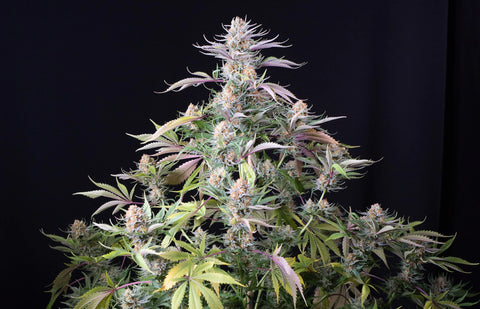
A number of scientific studies confirm that pinene has proven anti-inflammatory, bronchodilatory, and even anticancer properties. A clinical study conducted in 2011 demonstrated that α-pinene acts as an acetylcholinesterase inhibitor and is capable of modulating the activity of this enzyme, which may contribute to improved memory and cognitive function.
This is why we can conclude that it has the potential to mitigate the effects of THC. Most cannabis strains with high pinene content generally produce an energizing effect.
Limonene:
Limonene is a monocyclic monoterpene, which explains why certain cannabis strains offer that delicious, intense citrus aroma. We find that strains grown from the highest-quality cannabis seeds, which contain high levels of limonene, produce an invigorating effect. This terpene is found in certain aromatic herbs such as rosemary and mint, as well as in all citrus fruits.
From a physiological standpoint, limonene is known for its many antibacterial, antioxidant, and antifungal properties. Psychologically, it acts as an excellent natural antidepressant, as it has the ability to significantly improve mood.
Some scientific studies suggest that this terpene may help restore homeostatic balance. Given that imbalances in neuroendocrine and immune function (which directly affect homeostasis) are directly linked to psychosomatic or psychiatric disorders, limonene could be effective in treating conditions such as depression or various anxiety disorders.
Beta-caryophyllene:
β-Caryophyllene is a sesquiterpene found quite frequently in cannabis, as well as in basil, cloves, and cinnamon. It is responsible for the aromatic, slightly spicy, and woody notes found in certain strains. This logically explains why it is one of the active compounds in black pepper. This specific terpene could be considered a cannabinoid in its own right, as it selectively binds to the CB2 receptor.
Terpinolene:
Terpinolene is a terpene that is often found in a wide variety of cannabis strains, though generally in very small amounts. Strains in which terpinolene is the dominant component are rare. This terpene has a fairly complex sensory profile, as it can be described as a blend of woody, herbaceous, and floral notes.
It is found in lilacs, tea trees, apples, cumin, and nutmeg. Laboratory studies, specifically on mice, have shown that inhaling it produces sedative effects. It also appears that this terpene possesses anticancer and antioxidant properties. Other recent scientific research is also exploring the role of terpinolene in preventing coronary heart disease, in combination with other antioxidants.
Ocimene:
Ocimene has a mild , subtle floral and woody aroma . Like terpinolene, it is a terpene found in a very wide range of cannabis strains, though few have this aromatic component as their dominant feature. It is also found in a wide variety of plants, such as hops, kumquats, mangoes, basil, bergamot, lavender, orchids, and even pepper, in varying amounts.
Ocimene is widely used in the fragrance industry due to its sweet, floral, and herbaceous aroma profile. Scientific evidence suggests that it has anti-inflammatory properties. Generally speaking, plants produce it to act as a powerful repellent against insect pests, so it plays a protective role.

2) Secondary terpenes or sesquiterpenes:
They consist of 15 carbon atoms. The sesquiterpenes most commonly found in cannabis are carene (delta-3-carene), caryophyllene oxide, fenchone, humulene, linalool, eucalyptol, bisabolol, nerolidol (or peruviole), and alpha-phellandrene (a-phellandrene), camphene, α-β-Y-terpinene, farnesene, and terpineol.
Delta-3-carene:
Delta-3-carene is one of the main components of pine essential oils. It is known for its properties as a phytoncides (a term referring to a group of antimicrobial volatile organic compounds released into the air by trees and herbaceous plants); it also exhibits anti-inflammatory and anxiolytic effects. Furthermore, recent studies have shown that carene has a sleep-enhancing effect and that oral administration of delta-3-carene increases sleep duration and reduces sleep latency. It potentiates synaptic responses mediated by GABAA receptors by prolonging the decay time constant of inhibitory synaptic responses.
Caryophyllene oxide:
Caryophyllene oxideis a sesquiterpene epoxide whose scent can be described as fresh, sweet, dry, woody, and spicy. It is specifically a compound used by drug-sniffing dogs to identify cannabis. It interacts with the endocannabinoid system. It is commonly found in field wormwood, saltbush, cinnamon, sticky sage, and basil.
Fennel:
Fenchol has a strong, fresh aroma dominated by camphor. This terpene exhibits broad-spectrum antibacterial activity and may play a role in pain relief by inhibiting the TRPA1 receptor, a key protein in the body’s pain signaling system.
Humulene:
Humulene is also known as α-caryophyllene; it is a terpene found in the flowering cones of hops. Humulene contributes significantly to the anti-inflammatory effects of cannabis. It is also considered an active mechanism in the fight against tumors, as evidenced by its ability to produce reactive oxygen species (ROS).
Linalool:
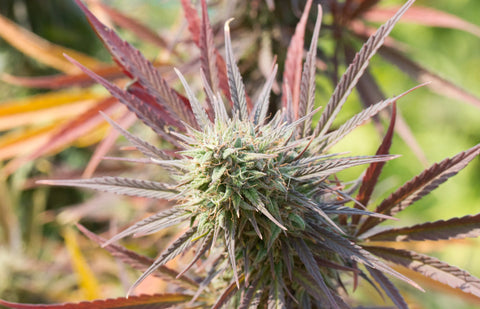
Linalool is a monoterpene alcohol widely found as a major component of plant essential oils, particularly in lavender and coriander. Linalool is not toxic in and of itself; in fact, it has been shown to possess a wide range of synergistic bioactive properties, including anti-inflammatory, anticancer, anti-hyperlipidemic, antimicrobial, antinociceptive, analgesic, and neuroprotective effects. Furthermore, linalool produces anxiolytic and antidepressant effects via the serotonin 5-HT1A receptor.
Eucalyptol:
As its name suggests, eucalyptol has a strong, fresh, distinctive, and slightly pungent eucalyptus scent. This terpene is commonly found in eucalyptus as well as in certain varieties of orchids. Scientific studies have shown that eucalyptol possesses clear anti-inflammatory and analgesic properties.
Bisabolol:
Bisabolol has a fairly mild scent, reminiscent of citrus and chamomile. It is found in chamomile and other natural herbs. It is a terpene widely used in the fragrance industry. Some scientific studies have shown that bisabolol possesses anti-inflammatory and antibacterial properties.
Nerolidol:
Nerolidol is a sesquiterpene alcohol found as a major component in the essential oils of neroli, Myrocarpus fastigiatus, and Brassia volanodosa. It is also present in smaller amounts in ginger, lavender, and lemongrass. This terpene is commonly used in perfumery due to its floral, fruity, fresh, intense, and distinctive aromatic profile. It is also used in the production of cologne. Nerolidol appears to possess antiseptic, energizing, and antifungal properties.

Alpha-phellandrene:
Alpha-phellandrene has a pleasant minty and citrusy scent. It is the main component of essential oils derived from certain varieties of eucalyptus. Scientific studies show that alpha-phellandrene may have numerous beneficial properties, such as boosting the immune system, as well as antifungal, anti-inflammatory, and analgesic properties.
Camphene:
Camphene is a terpene with a pungent, herbaceous odor. It is a major component of mastic gum oil. It is also found in smaller quantities in the essential oils of turpentine, cypress, camphor, lemongrass, neroli, ginger, and valerian. Camphene has cholesterol-lowering and triglyceride-lowering effects, which help improve the body’s internal regulation of cholesterol and triglycerides. It is also used in Ayurvedic medicine.
α-, β-, and γ-terpinene:
Alpha, beta, and Y-terpinene are found in allspice, eucalyptus, citrus fruits, juniper, tea tree, cardamom, and marjoram. The α (alpha) isomer is also being studied as an anticancer compound.
Farnesene:
Farnesene has a strong, fresh, grassy, and apple-like scent. It is found in small amounts in basil, apples, mint, and ginger. Some insects use it for communication. It is also present in certain plants, which use it as a repellent against pests. Farnesene is a component used in the manufacture of tires in the automotive sector, as well as in the creation of numerous fragrances in the perfume industry. It appears to possess interesting antibacterial properties.
Terpineol:
Terpineol is a monocyclic monoterpene alcohol found primarily in pine essential oil, as well as in other trees and certain plants (lavender, juniper, lovage, and marjoram). It is recognized by its scent, which is similar to that of lily of the valley, lilac, and hyacinth. Terpineol is used in soap manufacturing and for other cosmetic applications. A scientific study suggests that it may have beneficial effects in combating depression.
3) Tertiary terpenes:
These are the compounds found in small quantities in the cannabis plant: borneol, guaiol, cedrene, camphor, phytol, geranyl acetate, pulegone, cymene, and isopulegol (menthyl acetate).
Borneol:
Borneol is a monoterpene, identifiable by its minty, herbaceous, and even woody scent. It is found in ginger, mugwort, artemisia, rosemary, sage, oregano, and certain types of cinnamon. It is used by industrial manufacturers in the production of various insect repellents. It appears to play an important role in the entourage effect, complementing the action of other terpenes.
From a therapeutic standpoint, recent scientific studies have reportedly shown that it is quite effective in combating apoptosis in cancer cells; in other words, it induces their natural death. Other studies indicate that it also possesses antiviral properties, as it is a potent inhibitor of the herpes simplex virus type 1.
Guaiol:
Guaiol is a sesquiterpene alcohol with an aromatic profile similar to that of pine, and can therefore easily be confused with pinene. It is found in certain trees, such as guaiacum, pine, and cypress. Medically, it is of interest because it possesses strong anti-inflammatory, antimicrobial, antibacterial, antifungal, and antiviral properties.
Cedrene:
Cedrene is a sesquiterpene found in cedarwood essential oil, which is extracted from the tree of the same name. This terpene is a powerful natural insect repellent and anti-inflammatory agent.
Camphor:
Camphor is a bicyclic terpene derived from the camphor tree (Cinnamomum camphora). It is easily confused with borneol, as their scents are quite similar. It is an excellent antifungal and antiparasitic agent, as it is highly effective in actively combating pathogenic fungi and repelling harmful insects. Camphor has been found to possess beneficial antiseptic, anti-inflammatory, and antimicrobial properties.
Phytol:
Phytol is one of the main acyclic diterpene alcohols and a precursor to vitamins E and K. It is a very common terpene found in numerous chlorophyll-containing plants such as green tea, as well as in milk, eggs, and petroleum sediments. It has a strong, fresh, floral, balsamic scent, which is one of the reasons it is used in the cosmetics industry. Several scientific studies have shown that it possesses soothing, digestive, antioxidant, anti-inflammatory, and anti-carcinogenic properties, and that it also strengthens the immune system.
Geranyl acetate:
Geranyl acetate is a monoterpene with a distinctive floral and fruity scent reminiscent of roses. It occurs naturally in lemongrass, rose, palmarosa, and coriander oils. Geranyl acetate is widely used in cosmetics as a fragrance ingredient in the manufacture of soaps and creams. This terpene possesses soothing, antispasmodic, analgesic, and anti-inflammatory properties.
Pulegon:
Puleone is a monocyclic monoterpene that gives off a strong odor reminiscent of peppermint, pennyroyal, and camphor. This terpene is used in both aromatherapy and perfumery. It can be a powerful natural insecticide against pests, but caution is advised, as it can be toxic in high concentrations. Fortunately, pulegone is present in only trace amounts in the cannabis plant.
Cymene:
Cymene is a monoterpene with an intensely herbaceous and spicy aroma. It is commonly found in cumin and thyme essential oils. Numerous international scientific studies have shown that cymene is a powerful natural pain reliever and also possesses anti-inflammatory, antibacterial, antifungal, antiviral, and expectorant properties.
Isopulegol:
Isopulegol, also known as menthyl acetate, is simply a precursor to menthol; it is a monoterpene alcohol with an intensely minty aroma. It is found in pennyroyal and lemon eucalyptus. From a therapeutic standpoint, scientific studies have shown that isopulegol has analgesic, anxiolytic, relaxing, gastroprotective, and anti-inflammatory properties.