- There are many harmful natural pests that can affect cannabis plants, such as fungal diseases, plant viruses, and insect pests.
- Having recently covered the first two topics in depth, we will now turn our attention to the various types of insect pests that can attack our cannabis crops and cause partial or total crop loss.
- In this article, we’ll explain which insects can potentially appear in a cannabis crop, suggest preventive measures to limit this problem, and—most importantly—outline effective solutions for getting rid of each one. Follow the guide!
- What are the common pests in cannabis cultivation?
- What are the best preventive measures to take to limit their appearance on the cannabis plant?
- The Best Solutions for Eliminating Pests from Cannabis Plants
What are the common pests in cannabis cultivation?
Growers who already have some experience growing cannabis plants are certainly familiar with most of the insect pests mentioned here, as they have likely already encountered some of these harmful issues in their gardens.
We’re sure that pests such as mites—more commonly known as red spider mites—or various species of harmful flies, such as leafminers and whiteflies (aleurodes), as well as ants, aphids, thrips, caterpillars, scale insects, and nematodes, are no strangers to your beloved cannabis crops.
The Red Spider
What are commonly called “red spiders” are actually microscopic insects that are, in fact, simply mites. Red spiders most often appear in indoor cannabis crops when both humidity and temperature are high.
These pests feed by sucking sap from the leaves, which causes numerous bite marks on marijuana plants. This harmful infestation can spread rapidly and wipe out your crop in no time. That’s why you need to take immediate action…
The various symptoms are easily identifiable, as these pests leave behind traces of their feeding in the form of multiple puncture marks that appear as small white dots on the upper surface of the leaves. These symptoms can be mistaken for nutrient deficiencies; however, the likelihood of confusion is lower than with certain fungal pathogens.
These mites use the undersides of leaves to lay their eggs and raise their larvae; this is clearly their preferred breeding site. Since they measure only a few millimeters, they are not easily visible to the naked eye.
These spiders are not actually red, as their name suggests, because their color is closer to brown and orange than to red. As the infestation progresses, you will see a significant amount of spiderwebs forming on the plants, as well as various cocoons that become increasingly dense—a sign that your crop is completely infested.
If you reach this critical stage without having taken any preventive measures beforehand, then no insecticide treatment will be effective enough to permanently eliminate these spiders. In that case, you will have no choice but to completely halt your cultivation and thoroughly disinfect your space so that you can resume your favorite activity under more favorable conditions.
The leaf miner
The leaf miner fly is a true gourmet of the plant world, as these flies are selective and do not affect all cannabis strains in the same way. The leaf miner fly gets its distinctive name because, after laying its eggs inside the plant tissue of the leaves, the larvae burrow tunnels through them. This is clearly the critical moment when you’ll need to act quickly to save all the cannabis plants in your garden.
You may notice what looks very much like small galleries on the leaves, consisting of various brown lines, which indicate the precise moment when the larvae are burrowing tunnels through the plant tissue of the foliage. Quite simply, these flies devour all the plant material in their path; you may also observe small lesions caused by the adult flies.
Whenever possible, you should always give careful consideration to the varieties of the highest-quality cannabis seeds you plan to purchase.
Growers with relatively little experience in cannabis cultivation are often unaware that these various pest species are most often attracted to the terpenes and flavonoids in cannabis plants, which are concentrated in the delicious, thick buds covered in resinous trichomes.
The Whitefly (Aleurodes)
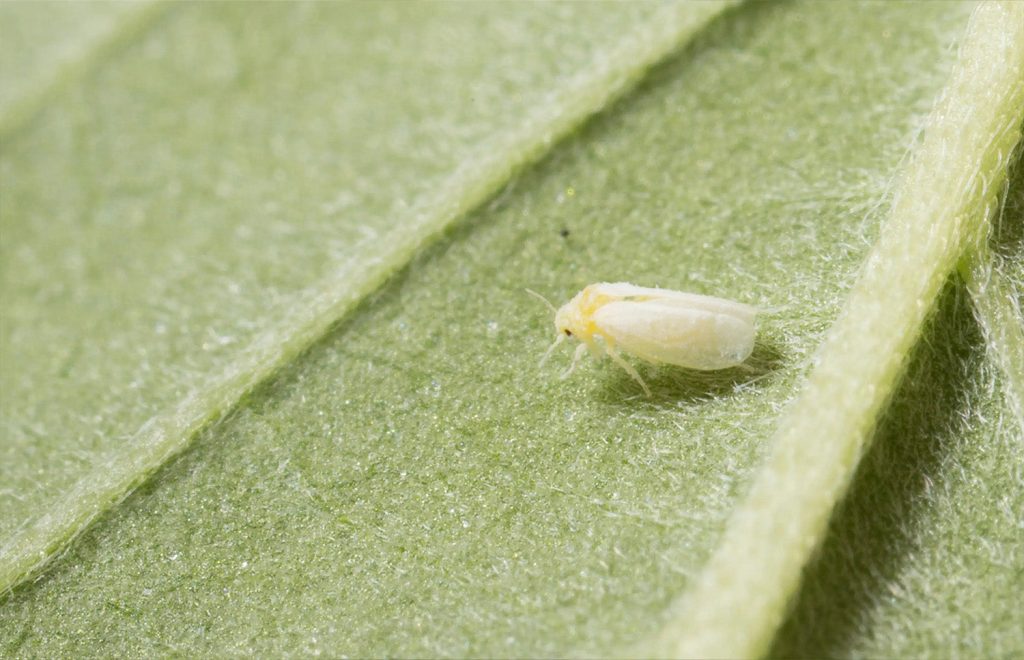
The whitefly is far from being the worst predator for cannabis plants, since it feeds by sucking the sap from the leaves. The downside is that this will gradually weaken the plants’ immune defenses.
It's fairly easy to spot whiteflies in your crops, because as soon as you touch or handle the marijuana plants, they fly up, and you can clearly see their white color.
Another sign of their presence is that some leaves will turn yellow due to chlorosis caused by a significant lack of sap in the plant tissues. You may also notice a substance resembling molasses—which is secreted by these pests—along with a fine white powder on the undersides of the leaves.
Ants
At first glance, ants may not seem like serious pests for crops, but it’s best to detect them and get rid of them quickly. Ants are attracted to cannabis plants because of the honeydew produced by whiteflies and aphids.
The ants feed on the plant's honeydew, which protects the aphids by allowing them to reproduce in large numbers undisturbed, since any traces of their presence are thus erased behind them.
We can also add that ants use an aggressive technique to penetrate plant tissues, as they can dig small tunnels within various parts of the plant structure, which could disrupt the root system—such as the flow of water and nutrients between the roots in the soil and the above-ground parts of each plant.
Aphids
Aphids may seem like small, harmless creatures from a distance; however, they are highly mobile and reproduce rapidly (producing 40 to 120 larvae per day). They are incredibly tiny, measuring only 1 to 10 millimeters—in other words, they are virtually invisible to the naked eye.
Aphids can be green, white, red, or black. Like spider mites, they feed on the sap in the leaves. Once you spot them, you need to act quickly, because these pests can quickly infest your crops.
Certain visual signs indicate their presence, as you will notice yellowed and dried-out leaves; this is because they establish their colonies under the leaves or stems, secreting a substance called honeydew.
As we mentioned in the previous paragraph, this honeydew—which is a typical characteristic of piercing-sucking insects that feed on plant sap—is highly attractive to ants, a fact that should certainly catch your attention.
Thrips
Thrips are pests that frequently attack cannabis plants and are generally difficult to get rid of. They also reproduce rapidly. You’ll notice their presence because of the silvery, woody trails they leave on the surface of the leaves after they’ve passed over them.
You may also occasionally see small dots, which are their feces; these should not be confused with the bites from red spider mites, which are much more numerous. The leaves become brittle as the infestation progresses over time, because thrips feed on the chlorophyll in the leaves.
An excellent and simple method for detecting thrips is to place sticky traps just above your marijuana plants, since some of them are bound to be attracted to the bright yellow color of the traps. This will confirm that a thrips infestation is underway in your indoor garden.
The Caterpillars
Caterpillars pose a real threat to our indoor and outdoor gardens, because once the adult butterfly has laid its eggs on the plants—which will later hatch into numerous larvae—you’ll quickly see the effects of their insatiable and destructive appetite on various plants.
These insects are voracious consumers of plant matter, as they feed continuously until they reach their maximum size. The next stage is the formation of their cocoon, which eventually gives rise to the chrysalis—the final stage of development before the butterfly finally emerges. Although it’s fairly easy to spot adult caterpillars, this would actually indicate that the infestation is significant.
That’s why, if you spot tiny , translucent, yellow eggs on the underside of the leaves, along with small black droppings and bite marks, you need to put a plan in place to eliminate them as quickly as possible. The caterpillars can also burrow into developing flower heads, which can cause pathogenic fungi to grow on them.
Scale Insects
Scale insects are tiny pests that attack marijuana plants both indoors and outdoors; they range in size from 1 mm to 1 cm and are gray to brown in color. There are nearly 8,000 species of scale insects in total; they reproduce rapidly, as a single female can lay between 500 and 2,000 eggs at a time, and a single individual can complete several generations of the same type in a single year.
Scale insects are therefore quite difficult to detect in a cannabis crop. They appear when temperatures are high and the humidity in the air is fairly low. Outdoors, a lack of water combined with intense heat creates conditions favorable to their emergence. Scale insects feed on the sap of plants, which gradually weakens them.
They move freely throughout the entire plant structure, leaving sticky trails as a sign of their passage. It is important to know that the secretions of this mischievous insect can cause a fungal disease known as sooty mold.
You could therefore end up with two problems in one, so it’s logically best to avoid having them around. Another crucial point is that these pests are difficult to eliminate using insecticides, even chemical ones.
Nematodes
Nematodes are small, round, slightly elongated worms, of which more than 25,000 species have been identified to date. Nematodes measure an average of 2.5 mm, which is why they are difficult to see with the naked eye. It’s important to note that half of them are pests that harm plants or animals. While some species of nematodes are beneficial, unfortunately many of them significantly affect cannabis plants.
Nematodes feed on plant cells, bacteria, fungi, and microorganisms found in the soil. The most harmful nematodes for marijuana plants are those that severely damage the roots.
The harmful effects become apparent quickly, as we see a sudden slowdown in growth or flowering, and progressive chlorosis in the leaves; if the infestation progresses to a more advanced stage, the roots may swell or wither, and subsequently take on a rougher appearance.
The unfortunate result of this is the slow, inevitable death of the plants grown from premium seeds that adorn your indoor or outdoor garden. Many growers might initially assume that the infestation is caused by various nutrient deficiencies, but in reality, the true cause of these problems is nematodes.
What are the best preventive measures to take to limit insect infestations on cannabis plants?
- Maintain stable air temperatures and humidity levels that are appropriate for each phase of the cycle
- Make sure the space is well ventilated and that the air is being refreshed at a rate appropriate for its size.
- Clean the growing area as much as possible, especially by making sure not to leave plant debris lying around
- Water the plants with the right amount of water and nutrients, while also ensuring that the pH and EC are properly adjusted
- Apply a broad-spectrum preventive treatment against insects and fungi halfway through and at the end of the growing season
- Thoroughly disinfect your space using cleaning products or broad-spectrum insecticides/fungicides between each cycle
- Never reuse soil or a used growing medium when starting a new growing cycle from seeds.
The Best Solutions for Eliminating Pests from Cannabis Plants
Red Spiders
To treat this pest, you can use a treatment made from neem oil, black soap, or pyrethrum oil. We do not recommend using chemical-based insecticides, as we have realized over time that these pests have become resistant to many of the chemical compounds currently available on the market.
Growers have relied on them too automatically, which has led to genetic mutations that make them resistant to this type of treatment. However, we strongly recommend the use of natural predators such as the “Phytoseiulus persimilis” mite for severe infestations, or “Amblyseius californicus” as a preventive measure. They are truly very effective; to ensure this, it is necessary to introduce and maintain a sufficiently large population throughout the entire life cycle.
The leaf miner
You can set out sticky traps to catch as many of them as possible—especially the adults—because that way they won’t be able to lay their eggs on the various parts of your most beautiful plants, which were grown from the highest-quality seeds.
Feel free to remove the larvae developing within the leaf tissue by hand using your fingernails or a sharp object; this will prevent further damage. Otherwise, your only options will be to apply either a treatment using a natural insecticide such as spinosad or, if the infestation is too severe, a chemical insecticide as a last resort.
The Whitefly (Aleurodes)
To get rid of them, you can use yellow sticky traps, or spray a solution made from neem oil or liquid soap every 5 to 6 days or so, until the pests are completely gone. Natural predators such as the “Encarsia Formosa” wasp or a species of bug like “Macrolophus Caliginosus” will also do a great job.
Ants
All you have to do is apply cinnamon to the affected areas, and they'll die quickly—it's a radical and natural remedy!
Aphids
We recommend introducing a natural predator, such as lacewing larvae—since they eat the pests—or ladybugs, parasitoid wasps, or the fungus “Verticillium lecanii, ” which will literally kill them.
Thrips
We recommend introducing a population of biological predators —either “Amblyseius swirskii” or “Amblyseius cucumeris”— onto your beautiful plants grown from seeds.
The Caterpillars
You can eliminate this problem by using a natural insecticide—which is simply an infusion of pepper and garlic—or by releasing “Trichogramma” wasps and “Podisus maculiventris” wasps into the affected area. The “Bacillus thuringiensis” fungus is also highly effective against these pests.
Scale Insects
To get rid of them, we recommend spraying them with a solution made of alcohol and soap. To prepare it, mix one teaspoon of liquid soap into a little lukewarm water, add 1 liter of water and one teaspoon of rubbing alcohol, mix thoroughly again, and you’re all set.
Nematodes
You can apply a bacterial agent such as “Pasteuria penetrans, ” which stops their population growth within a relatively short period of time, as it decimates their population at an early stage of development. This problem can also be addressed using fungal species such as “Arthrobotrys oligospora, ” “Entomophthora gypsophile, ” or strains belonging to the genus “Verticillium, ” all of which are highly effective.