
Table of Contents
Everything You Need to Know About Growing Cannabis from Seed
Cannabis seedlings are the most delicate stage of cultivation. However, this is also the stage that determines the future vigor of your plants—and therefore your yields. In this comprehensive guide, we provide you with all the keys to successful seedling growth, from choosing seeds to transplanting, including watering, lighting, and disease prevention.
What is a cannabis seedling?
A seedling is the young plant that emerges after germination. Fragile yet essential, it develops its first leaves (the cotyledons), followed by its true leaves. This is when the foundation of your future plant is laid. A healthy seedling will grow into a strong, healthy, resilient, and productive plant.
(photo of cannabis seedlings)
Understanding the sowing phase
As soon as the cannabis seed germinates and the first pair of leaves (the cotyledons) appears, it is referred to as a seedling. This young seedling is particularly fragile: its roots are just beginning to develop and its foliage is still forming. It is entirely dependent on the conditions you provide.
Light that is too intense, overwatering, or an unsuitable growing medium can be enough to compromise its development. However, a seedling that gets off to a good start has every chance of becoming a beautiful, productive, and resilient plant. It is therefore essential to try to establish the best possible conditions from the very beginning.
Choose high-quality seeds
First and foremost, it is essential to invest in good genetics. SILENT SEEDS cannabis seeds SILENT SEEDS a true guarantee of quality in many ways. The SILENT SEEDS team SILENT SEEDS the experience gained over the past twenty years at DINAFEM SEEDS—and thus with very high standards—to select the best traditional and modern genetic strains, ultimately producing cannabis seeds of the highest quality.
Once the seeds are obtained, various tests are conducted from germination to harvest to ensure we offer our customers cannabis seeds that have been tested and approved by us, guaranteeing the highest quality.
Cannabis seeds have been at the heart of our business for at least two decades, which is why we understand all the fundamental aspects that define a high-quality cannabis seed worthy of the name. We are fully aware that this final
represents the crucial starting point for cannabis cultivation—and, consequently, the potential issues that may arise later on.
Poor-quality, improperly stored, or poorly selected seeds can lead to low germination rates, stunted plants, which may exhibit abnormalities (various deformities, genetic mutations, etc.) or even hermaphroditic traits. The equation is simple: poor-quality seeds ultimately lead to significant financial losses, as well as wasted time and potentially various technical issues.
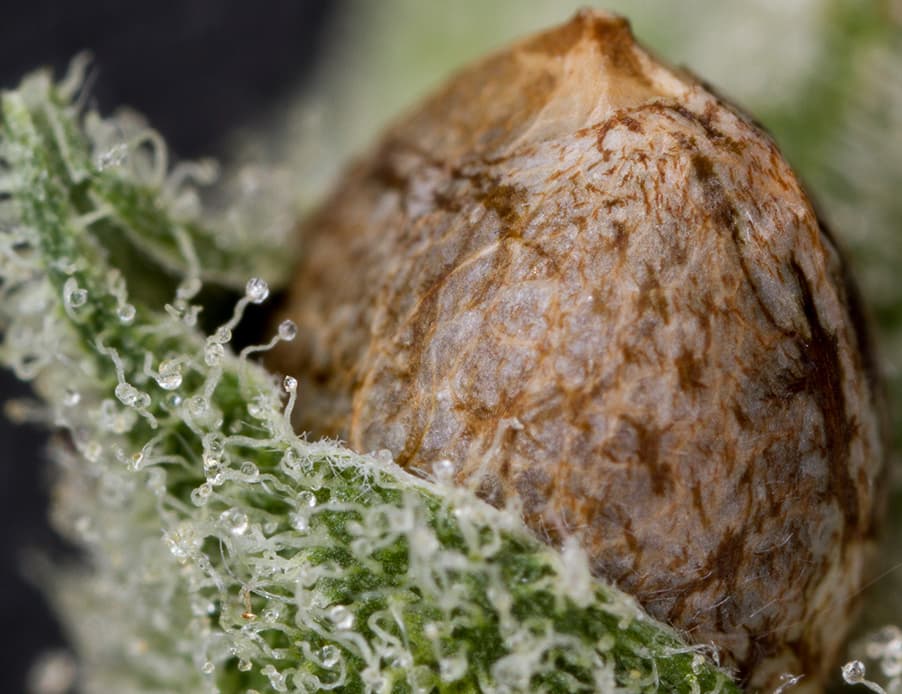
(beautiful photo of seeds)
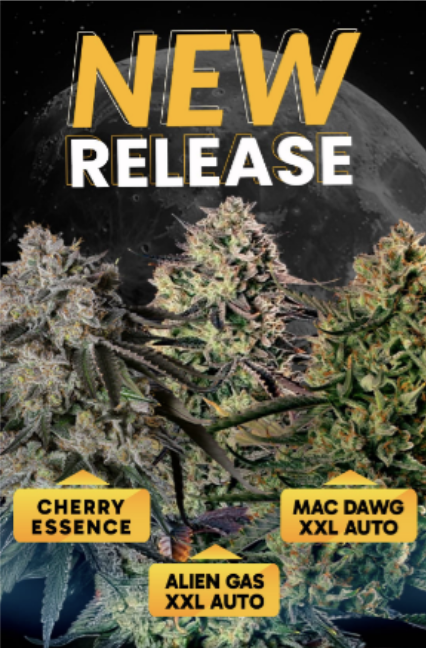
Opt for recognized strains that demonstrate good genetic stability and resistance to pests or varying climates, while being suited to your growing environment (indoor or outdoor) and your level of experience. If you’re a beginner, stable strains like Critical Mango, B-45, Moby Dick, Critical + 2.0, Alien Gas XXL Auto or even MAC Dawg XXL Auto are ideal. The choice of seed determines the rest of the process; this is something you need to keep in mind to ensure things go smoothly later on.
Create a supportive environment
Successful seedling growth depends on a stable, controlled environment. We strongly recommend starting your seedlings indoors, in a protected space such as a mini-greenhouse, a seedling tray, or simply under a clear dome. This helps maintain a constant temperature of around 22 to 25 °C and relative humidity between 65 and 75%, ideal conditions for the healthy, rapid, and optimal growth of your seedlings.
(illustrative photo showing climate, air management, air humidity, or symbols to simplify identification)
When it comes to containers, it’s best to start with small pots or peat pellets, which help control moisture levels and promote root development. Make sure there is good drainage, as standing water is the number one enemy of young plants.
How to successfully germinate your seeds
The paper towel method remains the most effective way to germinate seeds. It involves placing the seeds between two damp paper towels, which are then laid on a plate and covered with another plate to keep them in the dark. The whole setup should be kept in a warm, humid place. Germination usually takes between 2 and 7 days. As soon as the main root reaches about 1.5 to 2 cm, it’s time to move on to planting.
(photo of a germinated seed with a fairly large root, 1.5 to 2 cm if possible)
Planting sprouts
Transplanting germinated seeds into the growing medium must be done with care. The soil should be light, well-aerated, lightly fertilized, and have an ideal pH between 6 and 7. Plant the seed in a small hole about 1 cm deep, with the root tip pointing downward, then gently cover it without compacting the soil too much. Water lightly to moisten the soil without saturating it. At this stage, it is essential to place the seedling under suitable lighting.
(illustration or explanatory image)
What kind of light should I use for cannabis seedlings?
Young cannabis seedlings cannot tolerate overly bright light. Low-wattage CFL (compact fluorescent) bulbs are perfect for this stage, as are fluorescent tubes or suitable LED lights. They emit blue light that stimulates root development without burning the delicate leaves. A light cycle of 18 hours of light and 6 hours of darkness is recommended (corresponding to the growth phase). The distance between the lamp and the seedling should be approximately 15 to 20 cm.
(photos of the different types of lighting mentioned)
If you are growing outdoors, wait until the seedlings have 2 or 3 pairs of true leaves before gradually acclimating them to sunlight. It is necessary to expose them to natural light by first placing them in indirect outdoor light for at least two days, to facilitate a viable photosynthetic transition in terms of assimilating this different light spectrum, and then you can place your seedlings directly in full sunlight.
Watering: a delicate balance
Overwatering is just as harmful as underwatering. Cannabis seedlings need soil that is consistently moist but never soggy. To determine if watering is necessary, touch the soil or lift the pot: if it feels dry or too light, you can water it. Preferably use a spray bottle or a small watering can to avoid dislodging or damaging the roots. The water used should be at room temperature and slightly acidic (pH between 6.0 and 6.5). Avoid untreated tap water if it is too hard, as the pH is often above 7.
It is especially important not to overwater the growing medium, as mentioned in the previous section, but also—and above all—to water in a way that ensures the growing medium is moistened just enough so that the seedling or young plant absorbs nearly all of the water provided within a day.
Keep in mind that, much like the human lungs during breathing (inhalation/exhalation), you need to establish this absorption process on a daily basis to allow your growing medium to “breathe.” It’s important to promote soil aeration, as oxygen is vital for the development of seeds, seedlings, and ultimately, plants. You will gradually come to understand that the growing medium ultimately serves as both a respiratory system and a pantry for our beloved plants.
(Illustration or simple image related to watering)
Should you feed the seedlings?
Seedlings should not be fertilized. The growing medium used must contain enough nutrients to last for the first two weeks of growth. Any attempt at premature fertilization can cause stress or even burn the roots or seedlings, sometimes leading to their complete loss if too much fertilizer is used. Nutrients are only needed once the plant enters the active vegetative phase, which begins around the third week following germination.
Transplantation: When and How?
Transplanting should be done as soon as roots begin to appear at the bottom of the containers, or when the plant has 3 to 4 pairs of true leaves. It is best to proceed in stages: a 1-liter pot, then a 3-liter pot, before moving to the final pot. Avoid using pots that are too large from the start, as they make moisture management more difficult.
Successively changing pots provides vigorous growth for seedlings and young plants, as they benefit each time from fresh, nutrient-rich growing medium, giving them a real boost—which is excellent for growth. With this process, seedlings develop a better, more robust structure and have abundant energy, resulting in accelerated, efficient, and ultimately optimal growth.
For autoflowering plants, the rule is different: they must be sown directly into their final container. To do this, we strongly recommend choosing pots with a minimum size of 11 or 14L, or 20, 25, or even 30L if you have enough space available.
This approach is necessary with autoflowering seeds because their growth cycle is short— no more than twenty days for most autoflowering varieties—after which they flower automatically, regardless of the photoperiod. Seeds in this category therefore have a limited time to complete their vegetative growth, which does not give them time to recover from the stress of one or more successive transplants.
It is important to understand in this specific case that a well-executed growth period will result in a well-developed plant, meaning one with good structural form and, ultimately, good production capacity.
(Illustration or simple visual on transplanting)
Preventing Common Problems
Two major risks threaten your seedlings: damping-off and leggy growth. Damping-off, caused by a fungus— Pythium— found in overly moist soil , can cause your seedlings to die suddenly. To prevent this, it is crucial to control watering and ensure good ventilation.
At this stage, since the seedlings are very young, no fungicide can be applied, which means the seedlings will simply be lost. If you notice a sudden thinning of your seedlings’ stems starting from the base, accompanied by a sudden and prolonged slowdown in their growth, then there is a high likelihood that this pathogen is present.
(illustrative photo of damping-off)
Leggy growth, on the other hand, occurs when there is insufficient light:the seedlings grow abnormally tall (stretching) and become weak. To remedy this, place a suitable light source as close as possible to the plant as soon as the cotyledons appear.
(illustrative photo: wilting)
The seedling stage, though brief (1 to 4 weeks depending on conditions), is essential for laying the groundwork for a successful crop. By choosing high-quality genetics, creating a stable environment, and closely monitoring watering, light, and growing medium, you maximize the chances of seeing your seedlings grow into true champions.